
I am a Cold War kid… my awakening to Geopolitics came one morning about 1983 when I turned on the TV to see if there was any passable show to munch a second bowl of Smurfberry Crunch to – and was presented with a local talk show featuring a bunch of concerned looking adults commenting on a map of my home town with a set of concentric rings superimposed. They used words like “yield” and “overpressure”, and I was sufficiently astute as a 10 year old to come away with the impression that there were otherwise sane people on the other side of the planet who happened to subscribe to an alternate political persuasion and were capable of erasing me, my family, my sugary bowl of cereal and everything else I knew in 30 minutes or less like a Domino’s pizza delivery from hell.
Heavy stuff.
While my fascination with the logic of deterrence and Strategic Nuclear war is doubtlessly a manifestation of a trauma rooted in this experience, the subject itself has a broader, albeit macabre appeal to folks interested in examples of endeavors that evince the best and worst in humankind.
About the time I got “woke” to the reality of incipient Thermonuclear horror, my childhood gaming buddy plopped a copy of Ultimatum on the table and suggested we give it a go that afternoon.
To a kid accustomed to pushing panzers around Bastogne or brigades about Bull Run a la Avalon Hill, the prospect spending an afternoon with Ultimatum seemed a bit of a letdown. Ostensibly, the game entails allocating units carrying thermonuclear weapons to your opponent’s targets, and if the dice smile will it, placing a mushroom cloud which garnered you a number of victory points depending on the target.
Well, it took me a portion of a subsequent career as an Air Force ICBM Combat Crew launch officer and a class or two in operations research to truly grok how fascinating Ultimatum could be, and how it provides the civilian layperson a compelling glimpse at some of the more salient issues concerning the nuclear balance of terror in the ICBM age. I will provide a more in-depth critique of this game in later posts as I more fully explore some issues related to Strategic Nuclear warfare, but what I want to do in this post is relate some of the math involved in determining (near) optimal allocations of weapons given a set of targets for a small example, which can be later extended to the scenarios of Ultimatum.
I’ll wager most people who have played Ultimatum have played it using the “drop a bomb, roll some dice” approach. While this can be oddly satisfying, especially if you get to blow up the city you live in, one can achieve a much more optimum allocation of their arsenal if they are willing to do some math. I found a paper [1] produced by some Air Force officers back in 1973 around the time where computers were becoming powerful and available enough for researchers outside the largest corporations or think tanks to get a hold of and do real work with. I used their study to structure the equations I shall later describe.
Statement of the Targeting Problem
In this small example, the Blue player is tasked with determining an optimal allocation of available weapons for a first strike, counterforce release of weapons against a set of Red counterforce targets given a set of available Blue Missiles and Bombers. This framework will later be extended and applied to select scenarios in the Ultimatum game.
In this example, the red Counterforce targets are comprised of ICBMs (SS-9 and SS-7), Military Airfields and Command and Control Bunkers.
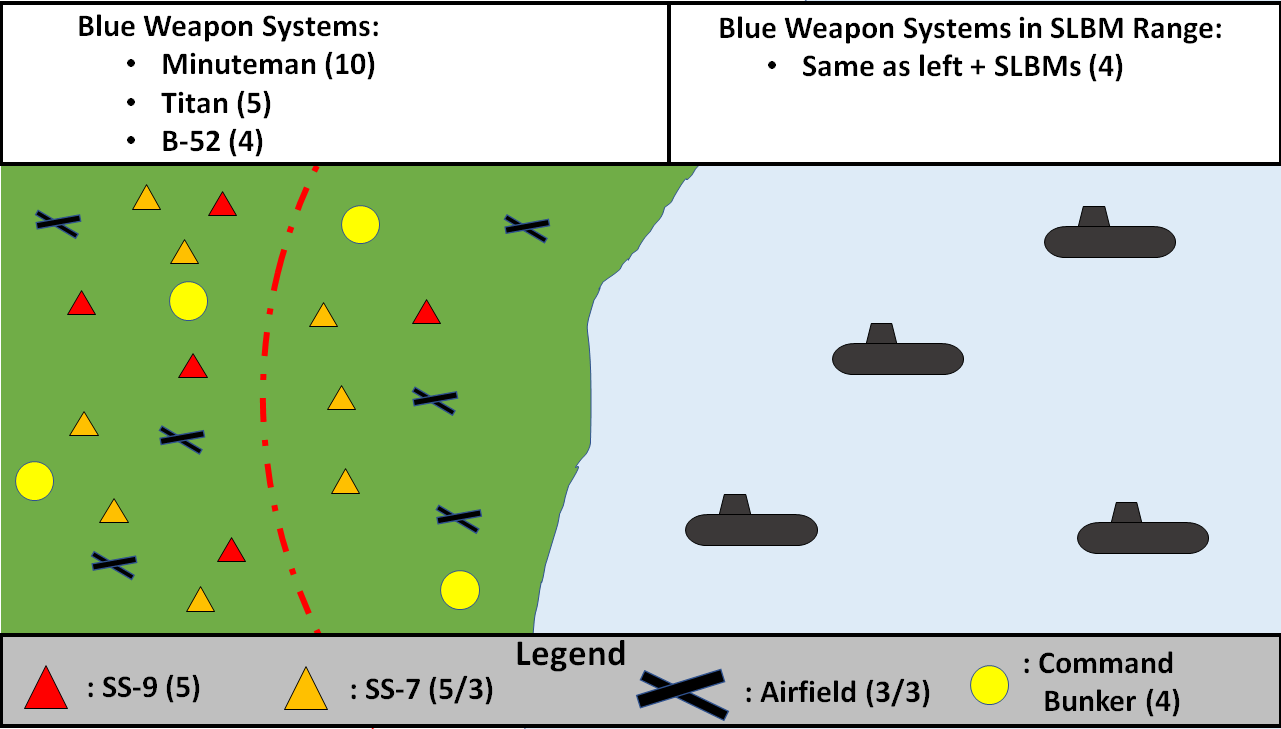
Weapons in Ultimatum are represented by counters, each of which represent ~20 ICBMs, a squadron of Bombers or the set of Sea Launched Ballistic Missiles (SLBMs) on a single ballistic missile submarine. Each counter has quantities representing their offensive and defensive power. The offensive power quantifies the accuracy, reliability, and weapons yield of the weapons system. The defense number characterizes the ability of that weapons system to resist attack on its base. In the case of ICBMs, this represents the degree of hardness of the silo housing the weapon. Airfields and Command Bunkers have associated defense numbers only.
To use a linear/non-linear program to allocate weapons, Blue must first determine which allocations of offensive weapons to targets make sense. Given the offensive potential of the blue systems (probability of target destruction per single unit allocation), only certain allocations of weapons to targets made sense. For example, SLBMs did not have the offensive power to attack Command Bunkers, so those allocations were not given as options to the solver.
In addition to offensive potential, the allocations need to model that Blue SLBMs cannot reach all Red targets. The offensive allocations needed to take into account whether if SLBMs where an option for covering a target due to the range to the target from SLBMs.
Blue weapons and Red Targets (characterized by hardness and whether they are in SLBM range or not) led to the following weapons allocations:
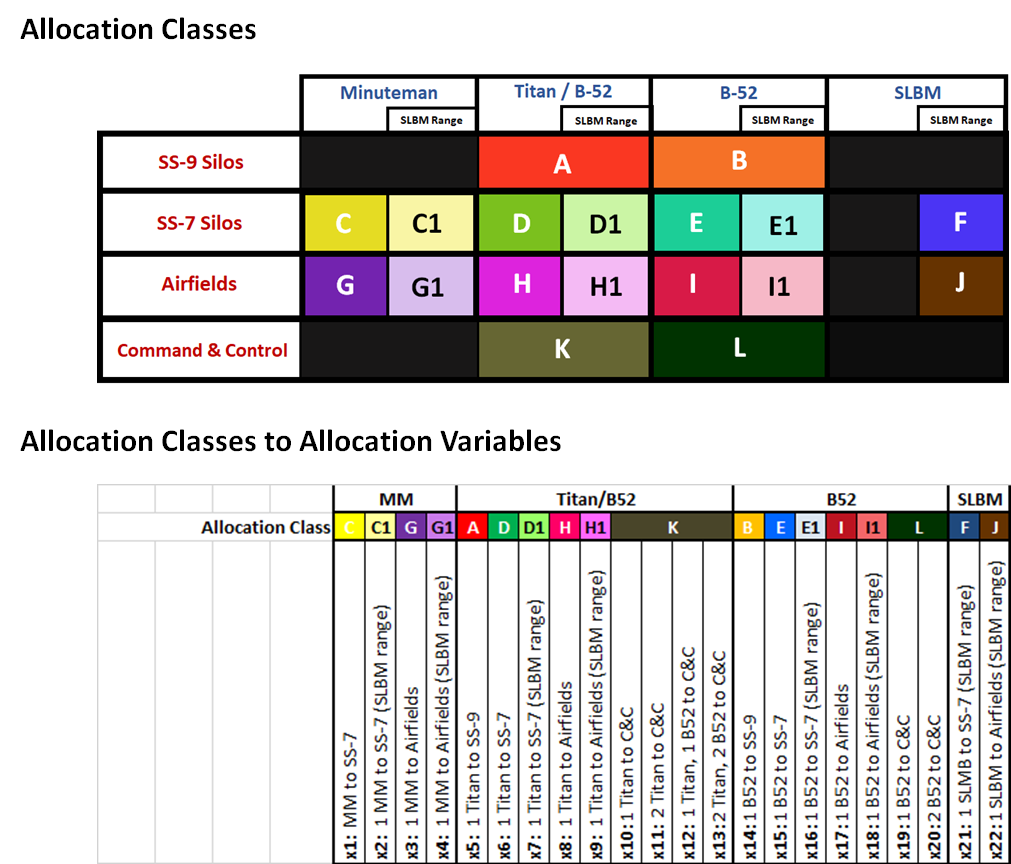
In the concept above, there are 12 major classes of allocation (the colors), pairing blue weapons systems to red targets. In this example the red SS-9 silos are immune to all blue weapons except the Titan and B-52 so accordingly, the SS-9 has two classes of weapons allocations on it (classes A and B). Similarly, Red Command and Control bunkers may only be destroyed by Titans or B-52s (classes K and L).
Within each class of allocations are sets of actual allocations coupling a number of each type of eligible weapons to allocate to particular target types. The solver provides a real number to the set of allocations to best satisfy the objective function.
The original game Ultimatum did not explicitly include Command and Control Bunkers (e.g. hardened targets such as Cheyenne Mountain), but I include them here to have another important class of hard target to allocate weapons to.
In the cases of very hard targets (e.g. Command and Control Bunkers), it made sense to target more than one weapon to an individual target. In these cases, there are allocations available for Multiple Titans, B-52s or combinations of the two to go after individual Command and Control targets to increase the probability of a kill.
Red SS-7 silos and Airfields are relatively soft targets and may be targeted by all blue weapon systems, including Minuteman and SLBM. However, only a set of SS-7s and Airfields are in range of SLBMs, so the classes allocating weapons to SS-7s/Airfields needed to be partitioned between targets in range of SLBMs (for which SLBM weapons could be traded off against the others) and the targets that were not in SLBM range. Classes F and J are for allocating SLBMs alone to targets, while subclasses C1, D1, E1, G1, H1 and I1 cover other weapon systems attacking targets for which SLBMs are also options.
The coupling of offensive potential of blue weapon systems to the defense rating of each red target was characterized as a probability of a kill of the single target by a single offensive unit. In a follow up to this post, I plan on revaluing the original offensive potentials of the respective weapon systems time based on the analyses documented in Savage and Martell’s “Strategic Nuclear War”. Ultimatum did not describe how they arrived at the values they did, but the high Circular Error Probable (CEP) of the Titan, of the Titan made it wholly unsuitable as the Counterforce (i.e. Hard-Target hitting) weapon it plays in this game. However, for this prototype, I used the offensive values coupled with the target classes to come up with probabilities of kills for weapon systems versus the various targets.
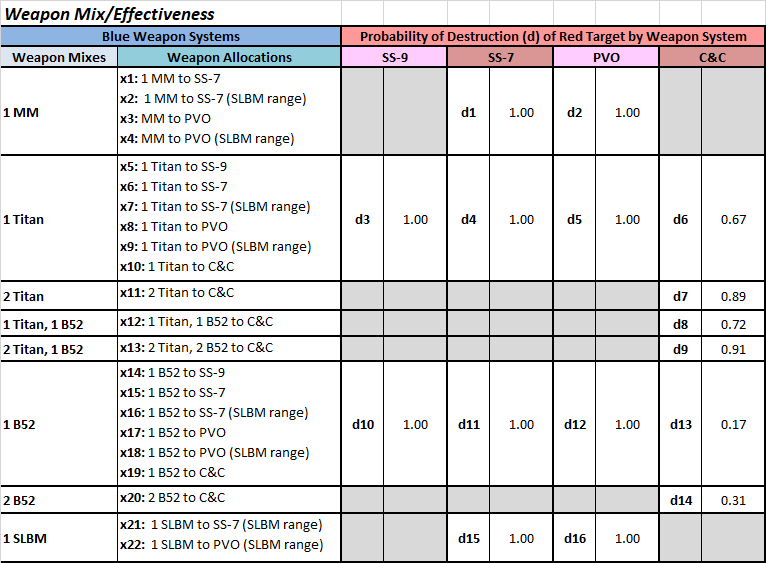
Allocations which are clearly inefficient (e.g. 2 Titans vs an Airfield) are not included as possible allocations as they are clearly a waste.
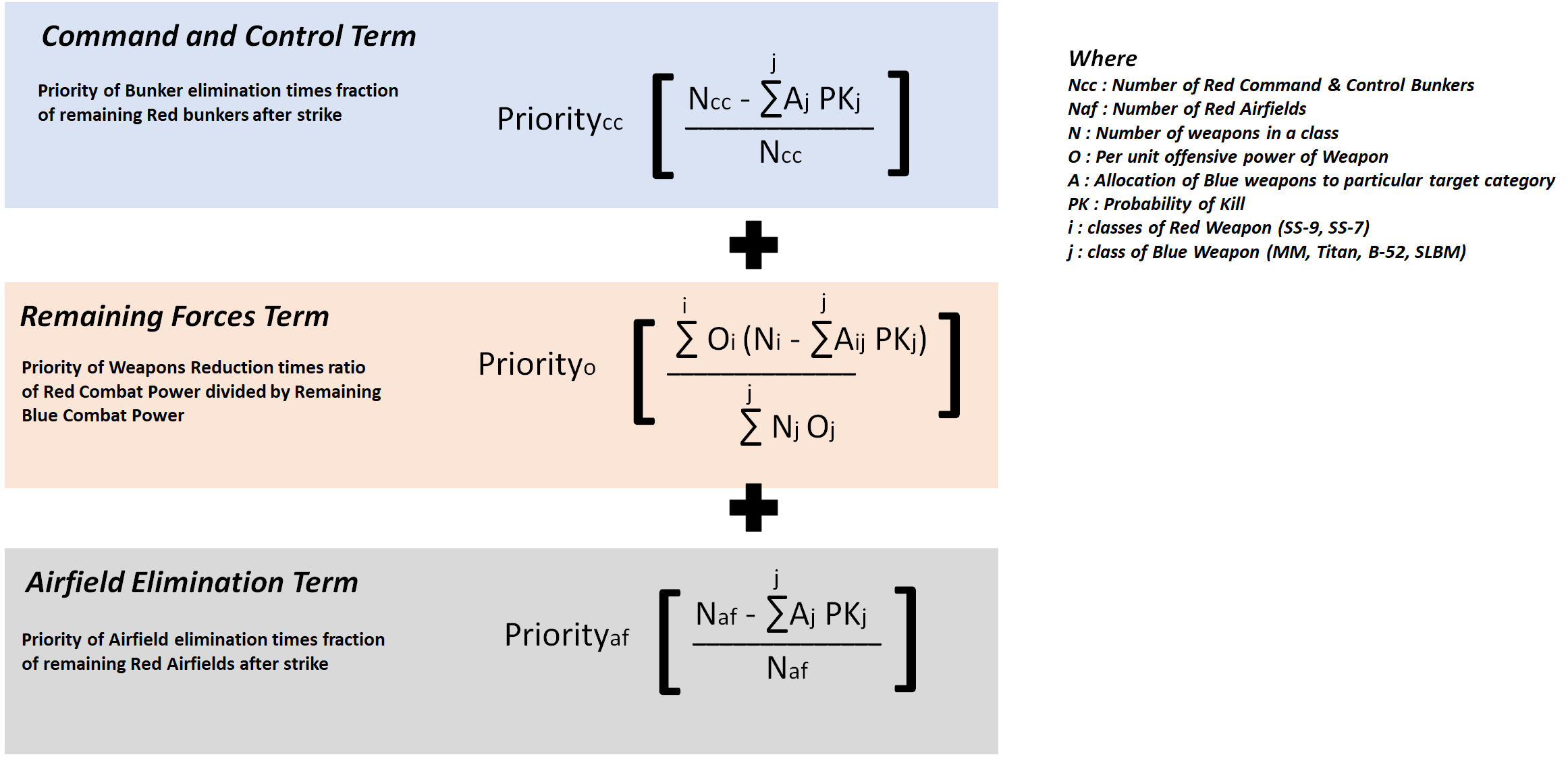
The Objective Function in this simple example considers three aspects:
- The ratio of Blue to Red combat power after the Blue Strike
- The ratio of remaining Red Command and Control bunkers
- The ratio of remaining Red Airfields
The ratio of remaining red to blue combat power is the number of weapons remaining multiplied by their offensive power. This reflects the need to economize the strike as much as possible, so that blue has weapons remaining for subsequent stages of the conflict. This accounts for both red weapons destroyed in the strike (emphasizing reduction in red offensive power) and blue weapons remaining after the strike (driving economy in blue use of weapons).
Elimination of Command and Control bunkers is a central aim of countervalue concepts featuring decapitation, but as many analyses (including Savage and Martell’s book) posit, eliminating enemy decision makers could have the downside of leaving the opponent with no effective strategic command and control and lead their directionless residual force to conduct retaliatory countervalue (a.k.a. city busting) strikes with their remaining forces. However, for this example I include it as an option which can be prioritized in the objective function.
Lastly, the ratio of remaining airfields was included to give a soft target option for the solver to work with. In a later analysis, airfields will be targeted for the bombers and defense fighters operating from them.
These three terms were summed in an Objective Function to be minimized by the solver, each multiplied by a scalar priority.
The solver was run for two sets of targeting priorities and three sets of blue weapons to be allocated against a constant set of Red targets:
- 5 SS-9 Silos
- 8 SS-7 Silos (3 in range of Blue SLBMs)
- 6 Airfields (3 in range of Blue SLBMs)
- 5 Command and Control Bunkers
The solver solutions are presented as a set of six scenarios based on the combo of targeting priorities and Blue Weapons availability.
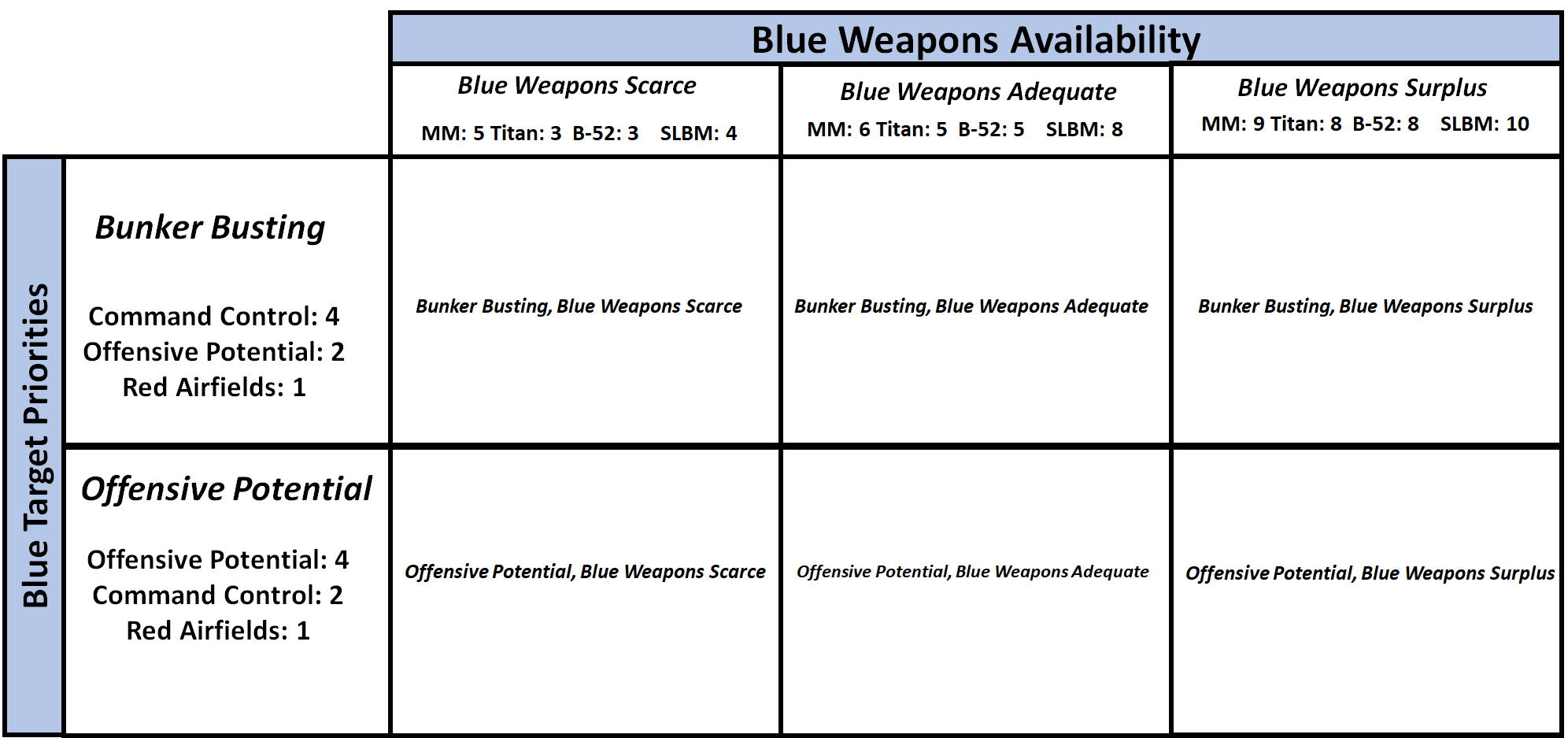
Blue Target Priorities models the relative priorities given to the three objective function terms described above. The objective terms are given weights in the objective function. Case Bunker Busting gives highest priority to reducing the number of Red Command Control bunkers. Case Offensive Potential gives highest priority to improving the ratio of Red to Blue offensive power. Both cases rank Red airfield elimination last.
Blue Weapons availability models the availability of Blue Weapons to allocate to red targets.
Results
In all cases, the solver was able to drive the objective function to very near zero reflecting near optimal solutions as far as the objective function is concerned.
The solver used was the evolutionary solver in excel which minimized the given objective function (with given priorities) via non-integer allocations for the constraints given. Since the allocations are non-integer, I took the extra step of rounding each solver allocation output to the nearest integer. For example, if the solver gives an allocation of 0.3, I round to 0 which is interpreted as ‘do not release this weapon on that particular target.
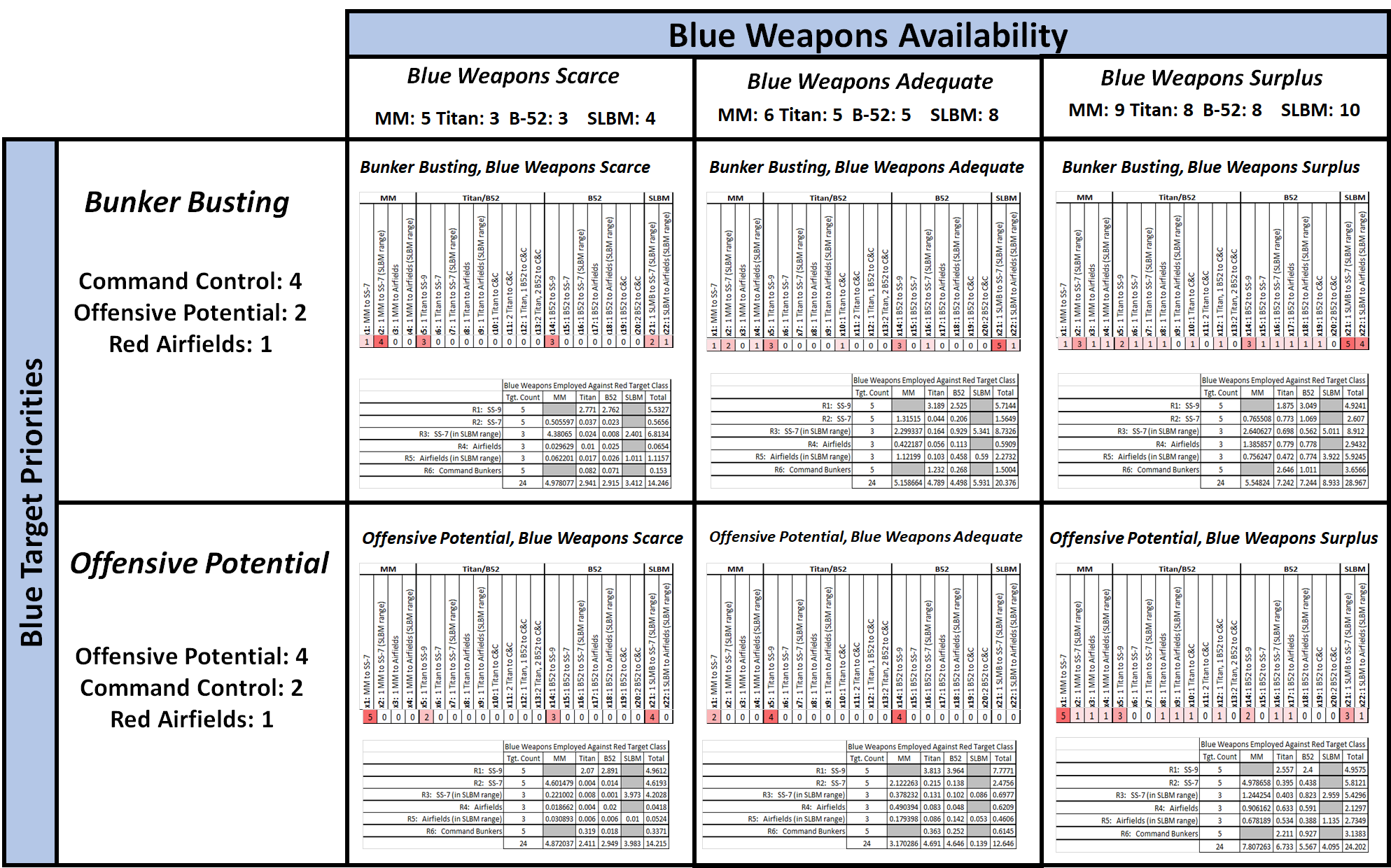
In general, the solver has a marked preference for eliminating SS-9 Silos, which is understandable given the combat power of the SS-9 vis-à-vis the SS-7 (65 vs 20). Command Bunkers are the hardest of targets, and the solver does not allocate against them unless there is an adequate or surplus of blue weapons regardless of the targeting priority.
Bunker Busting Targeting
The three bunker busting outputs made sense given the objective function. Note that even at the relatively high priority for targeting Command and Control, the solver does not target bunkers until more weapons are available.
Offensive Potential Targeting
In Offensive Potential targeting, the solver allocates to minimize the ratio of Red to Blue combat power. Minimizing this ratio has two parts – eliminating Red weapons and economizing on the use of Blue Weapons. Accordingly, Red Airfields are completely ignored in targeting up until the Blue surplus weapons case. In the Blue Weapons Adequate case, you see the solver primarily withholding blue weapons; eliminating the SS-9, while destroying 2 SS-7s with Minuteman shots. Withholding the Minuteman vs the SS-7 makes sense since the combat power of the Minuteman is less than the SS-7 (15 vs. 20) and withholding these weapons does more to improve the force ratio than destroying the SS-7s. This logic holds for the blue SLBMs as well.
Conclusions
The prototype gives answers that make sense, so I think this is something that I can scale to scenarios in the Ultimatum game. Later post will revisit the offensive and defensive values used in the game, more fully taking into account weapons system attributes such as yield and CEP.
References:
[1] Maj. William T. Hodson III, Maj. William Goodyear, Capt. Wolfhart Goethert, USAF “A Linear Programming Approach to Weapon Allocation”, National Technical Information Service, 1971.
[2] Bernard Brodie. “Strategy in the Missile Age”, Rand Corporation, 1959.
[3] William Martel, Paul Savage, “Strategic Nuclear War”, Greenwood Press, 1986.