Much in the spirit of Fred Janes’ pamphlet “Your Navy as a Fighting Machine”, Fred Jane’s monograph on the purpose, form and function of the Royal Navy shortly before the outbreak of World War I, I decided to put together a post covering such matters on our nascent Space Force along with some musings about its future. Since it is still early, and there is not much published on doctrine, organization, and more importantly about the threat environment faced, this was an opportunity to put out a set of “bar bets” about what early challenges the service may face and forces that may drive it’s evolution. As a layman, I am extrapolating from the history of the US Space Command and a set of open source works relating to Space Capabilities and Doctrine.
What is the Purpose of the United States Space Force?
In a manner similar to the Navy, the Space Force will be in the “Links” business; the object to be controlled is the ability to convey something of value through a medium and deny adversaries the capability to do the same. In contrast to the business of the Army (to seize and hold nodes) and the Air Force (the ability to destroy nodes around the world), the United States Space Force (USSF) will have the job of ensuring the US and allies may use space to mediate a Line-of-Communications (LOC) while denying adversaries that ability. In the case of space, Line-of-Communications generalizes to everything that can provide value to the US and friendly nations by going in, though and back from space. Examples include electromagnetic spectrum (e.g. images from space, communications), Warheads (ICBMs) and spacecraft. Much as the navy’s job can be summed up as “providing the ability to influence land from the sea and denying that to the enemy”, thus will the USSF do with space.
Useful Similarities, yet some Differences
A number of writers on space doctrine started with terrestrial analogues for useful parallels with Maritime (e.g. Corbett) and Airpower (Douhet) doctrines. Both of these domains provide insights useful for thinking about Space Doctrine.
As mentioned, force in the Maritime Domain is wielded to control the “Links” between the nodes; the operationalization of this being the control of Sea Lines-of-Communications. To this end, contestants vie to achieve Command of the Sea; a condition where friendlies may utilize the medium while denying the enemy the same. The chief means of effecting this are sea control (measures providing our side with preponderant capability to utilize the medium) and sea denial (denying the enemy the means to use the medium, but not necessarily giving us the ability to do so). Each of these means has a ready analogue in Space Doctrine. Command of Space readily corresponds to Command of the Sea in the way that it is not necessarily an absolute (you can have useful, local command that can be useful) condition, but can be judged as a manner of degree. The notions of Space Control and Space denial also can be derived directly from the Maritime domain.
The topography of the exercise of force between Space and the Sea also have more in common than immediately meets the eye. Navies seek to exercise influence on designated land areas by the coordinated efforts of dispersed, specialized elements (e.g. Carriers, Submarines, Aircraft). Space Forces will also have the ultimate object of terrestrial influence (e.g. Observation/Intelligence Gathering, Ballistic Missile Defense) and use a set of coordinated, specialized elements (Spy Satellites, Sensors, Laser Battlesats, etc.) to do so. While things in orbit are constantly in motion, orbits can usefully be thought of as locations defined by their size (altitude of satellite), inclination (governs the range of latitudes the satellite will overfly) and other attributes. Space elements will need to coordinate from a range of orbits in order to provide overall, emergent capabilities described in the next section.
While Maritime Doctrine is more instructive, Airpower Doctrine has some important lessons for Space Doctrine as well. Classic Airpower doctrine emphasizes the strength of the offensive in operations, and the same may be true of Space. Space assets may be relatively few in number, and relatively fragile. Negation of few assets may lead to precipitous degradation of combat power of the overall force. Being space, replacement is relatively slow.
What will the Space Force Do?
Much has been written on how space has become indispensable in modern warfare, especially for first-rank, expeditionary powers with global commitments such as the United States. It is arguable that the American way of war with its reliance on precise timing and navigation, intelligence-gathering from a distance and secure, reliable communications is impossible without space. Our adversaries have taken note, and the technologies necessary for denying space are rapidly proliferating. It made sense for the U.S. to vest a group with the responsibility to ensure the security and effectiveness of spaceborne capabilities as a whole as their sole charge.
The first job of the USSF may be to secure our spaceborne capabilities through space surveillance and other measures, but I argue that to do this and other things an offensive capability may grow in importance. It will not be enough for the US to detect and dodge threats; increasingly we will need to emphasize means for temporarily (e.g. Jamming) or permanently (ASATs) negating hostile assets in space.
It is my conjecture, that as a “bonus”; the ability to destroy things in space from space will provide the ability to provide defense from smaller (~a dozen missiles) ballistic missile attacks. Ballistic missiles remain an effective, increasingly assessible means of exercising strategic effects (shaping a conflict) by the tactical expedient of launching a rocket, regardless of the explosive type. A past example is the Iraqi Scud strikes on Israel in the first gulf war. Even with conventional warheads, the use of these weapons jeopardized the Arab participation in the U.S. coalition by threatening to draw Israeli retaliation. These missiles are being fielded by more and more nations. As part of the counterspace job, these assets may also be used for destroying said missiles, at least for the small attacks possible by nations such as Iran.
This leads to the “back to the future” scenario of spaceborne missile defense as described in the star wars initiative of the late cold war in the 1980s. The functionality of the Ballistic Missile Defense reference scenario is also what we would need to use in the counterspace mission.
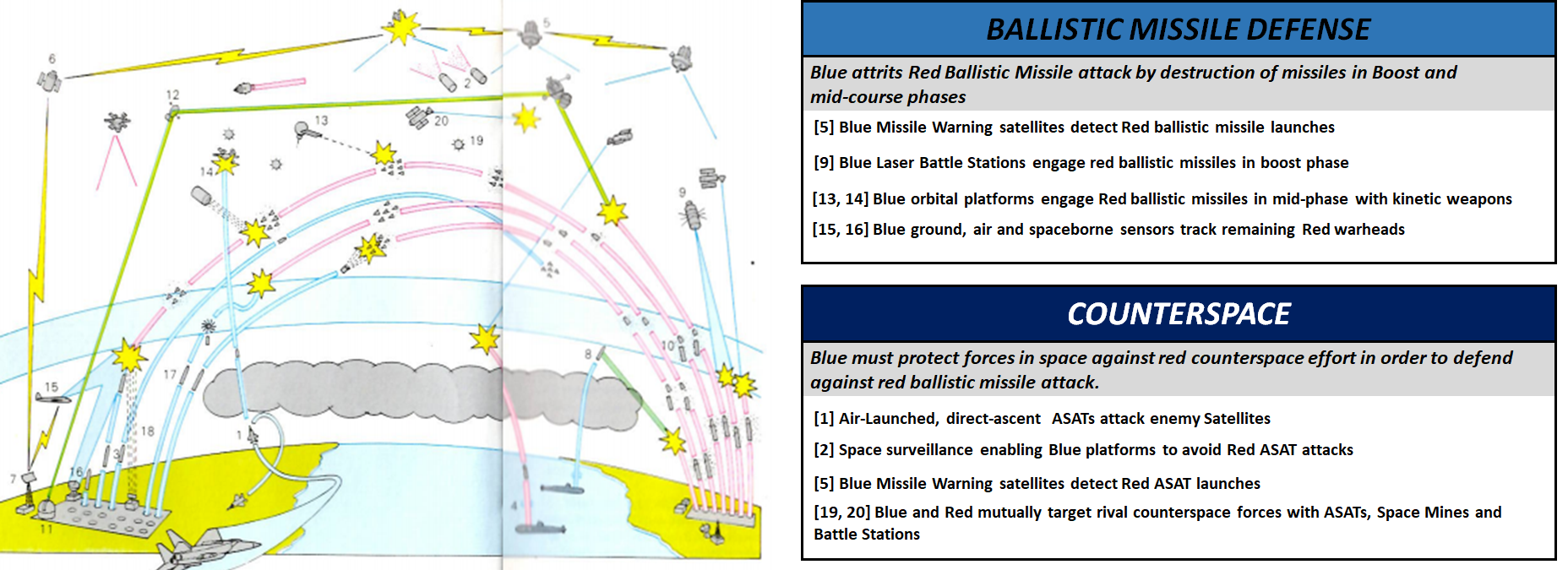
Ballistic Missile Defense/Counterspace Scenario (adapted from [Hobbs])
While the United States Space Force (USSF) is brand spanking new, it continues the roles and missions that had been covered by the joint United States Space Command. The USSF can be thought of a grouping elements from this joint command into a service that can fight and win in space. These joint functions of Space Operations had been summarized in documents such as Joint Publication 3-14 Space Operations. These functions (standing capabilities) are applied to Missions as sets of tasks. The figure below sums up some of the more important functions and their applications to some of the mission the space force may be called upon to perform.
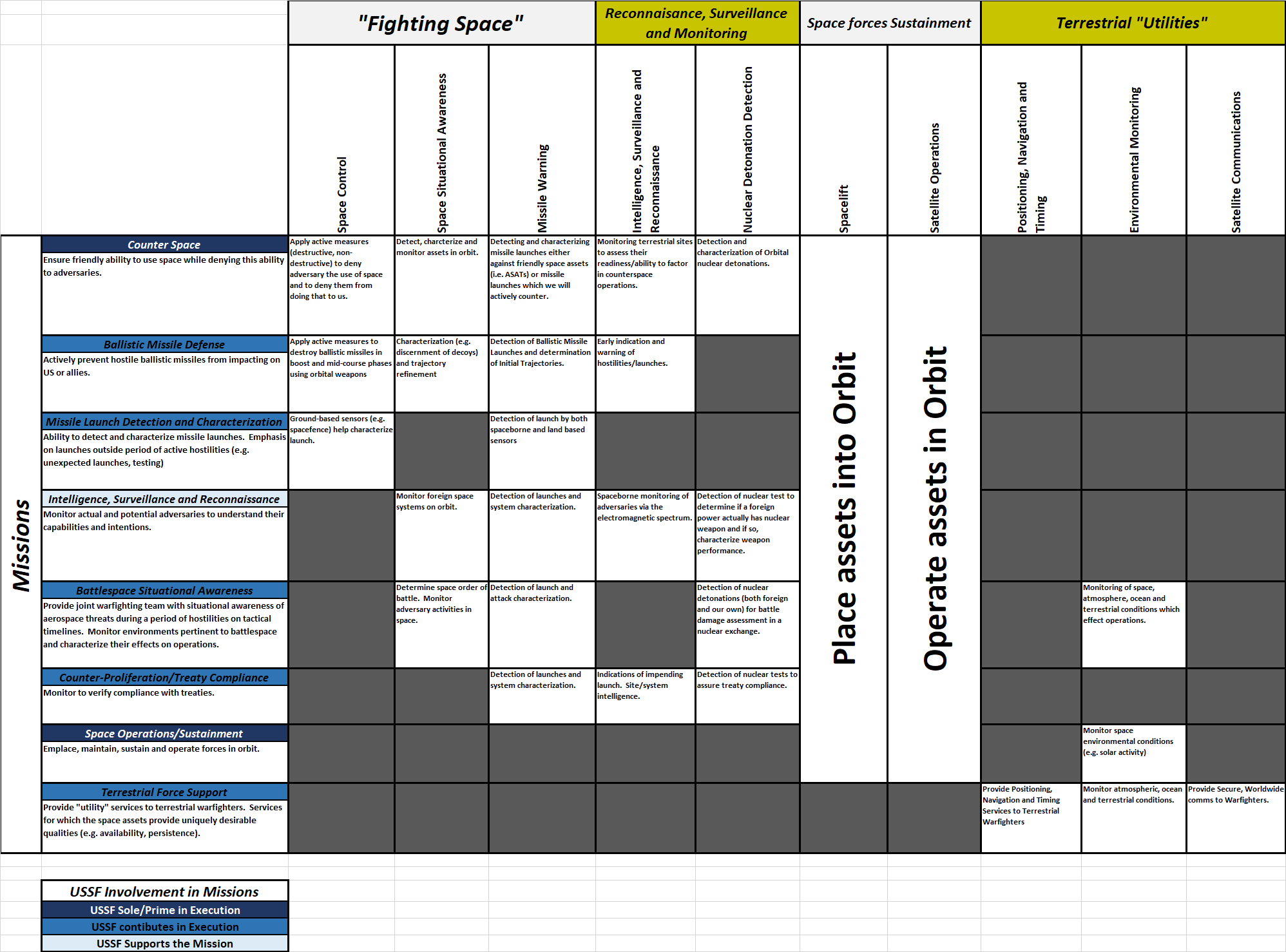
Space Force Functions (Columns) to Missions (Rows)
(Re)Introducing the Laser BattleSat
A key element in the Star Wars Ballistic Missile Defense architecture was the Chemical Laser Battlesat. While the BMD architecture also featured such exotics as laser-reflecting mirrors and X-Ray lasers, the Chemical Laser Battlesat was the most feasible, mature force-projecting option. While ASATs are currently fielded by a number of nations, the Battlesat never became operational.
Laser Battlesats have a number of advantages over conventional ASATs (which rely on impacts and are one shot, one kill), but the prime benefit is that a Battlesat would be able to negate space assets “wholesale”, while ASATs would kill “retail”. The number of targets a laser Battlesat could negate would only be limited by the quantity of reactant it carried, versus the one-and-done attack of an ASAT or Space Mine. A Battlesat in the right orbit with enough range would be able to hold targets in a very large volume of near-earth space at risk. Attacks from a laser Battlesat could come with little to no warning as hostile assets wink out of operation one by one.
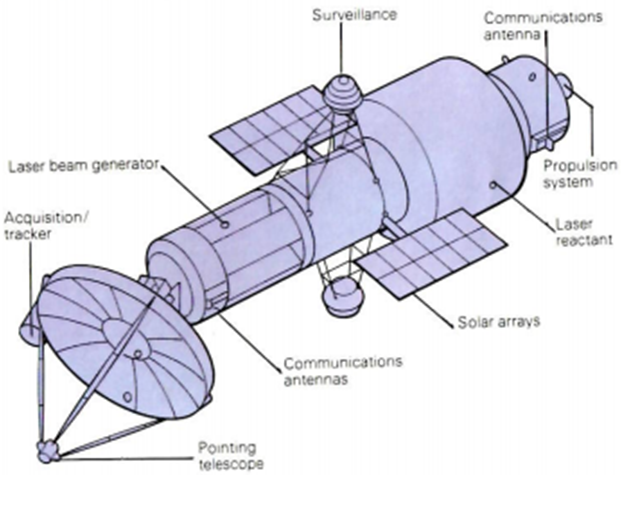
Laser Battlesat – Representative Model (from [Hobbs])
The enabling technologies (e.g. Pointing, Tracking, Power Generation) have much advanced since these systems were first being developed in the 1980s and would probably be readily fielded if the resources were made available. Given the capabilities, I would expect fielding Battlesats would be immensely destabilizing, and we would need to be prepared to seize and hold the lead in such systems or prevent an arms race by treaty means.
Does the USSF have a Song Yet?
There is an unofficial requirement for some kind of “Theme Song” – the Marines have a Marine Corps Hymn, no one knows the Army Song, but they have one. The USSF has its work cut out for it on this front, since most of these songs center on a glorious history of killing people and breaking things in a storied past. I’d recommend that the USSF break a little with the tradition of a song with words for a theme song. My recommendation is just peppy and campy enough to fit the bill, in my opinion.
Ladies and gentlemen, my recommendation for the Space Force theme is; “Telstar” by the Tornados (1962).
References:
[Hobbs] Hobbs, David “Space Warfare” Prentice Hall 1986.
Steven J. Bardwell et al. “Beam Defense – an alternative to Nuclear Destruction” Aero Publishers 1983
Klein, John “Space Warfare – Strategy, Principles and Policy” Routledge 2006
Joint Publication 3-14 “Space Operations” CJCS April 2018
Lupton, David LT Col (USAF) “On Space Warfare – a Space Power Doctrine” Air University Press 1988
Corbett, Julian “Principles of Maritime Strategy” originally published 1911
Douhet, Giulio “The Command of the Air” originally publish 1921