As covered in a previous post, the US Maritime Strategy marked the high water mark of the responsibilities of the US Navy. For the first time in its history, the US faced a truly global maritime threat that needed to be met with maximal force simultaneously in theatres around the world. Unlike WWII where the US elected to handle Nazi Germany and the Japanese empire in serial, WWIII at sea would have required free world forces to aggressively seize and hold the initiative in multiple theatres simultaneously in order to prevail.
While generally well received by warfighters, and cogent and persuasive enough to legislators to countenance the 15 Carrier Battle Group/600 ship navy required, there were a number of criticisms of the Strategy which could reasonably lead one to question the plan’s viability. In the next few posts, I will blog how I put the Maritime Strategy through its paces using contemporary documentation/intelligence assessments to guide Soviet and Free world play and using the boardgame “Seapower and The State” as the simulation.
Selected Criticisms of the US Maritime Strategy
Tactical Nuclear Readiness
The US Maritime strategy understandably plays to the strengths of the Free World alliance; advantages of relatively free access to the oceans and access to material resources (which unfortunately must be transported over vulnerable SLOCs). While the strengths of the Free world navies were though to be strongest in a longer, conventional struggle (i.e. time to eliminate the soviet navy at sea and to bring full firepower to bear on vulnerable Soviet flanks), the enemy gets a veto – and that veto could have come in the form of tactical nuclear weapons.
As a number of commentators had noted [e.g. Polmar, Van Cleave and others], the US Maritime Strategy seemed to treat tactical nuclear warfare as an undesirable contingency as opposed to a very likely condition that needed to be explicitly countered in the strategy.
As I found while doing the appreciation, the Soviets were well equipped for tactical nuclear warfare at sea, particularly in terms of standoff weapons delivered by aircraft. The US Maritime strategy specifies that Free world forces would deny the soviets access to the oceans by applying forward pressure, but this forward presence would have put forward battlegroups in a situation of grave disadvantage if (indeed, when) the Soviets elected to employ tactical nuclear weapons.
Strategic Escalatory Hazards of an anti-SSBN strategy
Another potential issue with the US Maritime Strategy was the focus on destruction of Soviet SSBNs as a means of forcing the Soviets into decisive battle. The idea was to attack something the Soviets had little choice but to defend, and in the process annihilate their war-making ability at sea. Critics pointed out that such an approach might force the Soviets to “use or lose” their SSBN-launched missiles if faced with the destruction of a significant number of them. This question might need other games to more explicitly treat the issue of strategic (nuclear) stability (i.e. what do I do if my secure second strike is in jeopardy?), but my selected game will at least provide a context for it.
An Appreciation of the Situation via “Seapower and the State”
After reading a bunch of books and briefs, I found a game “Seapower and the State” which covers the situation (WWIII at sea) at the level (Global) necessary to treat the scope of the US Maritime Strategy.
My hats off to Stephen Newburg for his treatment of the subject; nothing but respect for being able to make a game that covers so much territory in a mere 13 pages of rules.
Below are some house rule adjustments I made in order to tweak the game to more adequately cover my questions.
Escalation Model (Level Effects – 5.3)
The game has 5 levels of conflict ranging from peacetime ops (level 1) to conventional combat (level 2), tactical nuclear (level 3), operational (theatre) nuclear (level 4) and strategic nuclear combat (level 5). As you might imagine, the game ends with a strategic nuclear exchange (or turn 10 of combat).
As called out in the 1984 publication of the Maritime Strategy, a major Uncertainty faced by the strategy was the potential for escalation to nuclear combat (tactical, theatre, strategic) [NWPT 33, pg 96]. It was assessed that nuclear war at sea would be a net disadvantage to the Free World forces. In looking at the situation though the game, I agreed with this assessment. While the Free World surface and submarine forces generally match the Soviets in availability of tactical nuclear weapons, the Soviets Air units in the game have tactical nuclear capability while the Free World allies do not.
The 1984 publication of the Maritime Strategy also makes the point that use of nuclear weapons on land would likely drive whether they are used at sea or not. Most geo-political assessments of WWIII revolved (correctly in my opinion) around the “Central Front”; the struggle for the Federal Republic of Germany. In a general conflict (as opposed to a regional war in the Persian Gulf or Korea) with the Soviets, a major aim of the Soviets would be neutralizing NATO by either overrunning West Germany or capturing enough of it to force a costly settlement from the West. Therefore progress (or lack of it), on the Central Front would have been a major escalation driver for the Soviets. The example given in the 1984 Maritime strategy says that if the Soviets seemed to be doing well on land conventionally, they would be less likely to use nuclear weapons on land and much less likely to escalate to their use at sea. This makes sense, since the object of the conflict would be won on land (even more so for the Soviets), and if it seemed that their armies could achieve the main object on land conventionally, it would not do to risk it all by allowing escalation at sea.
As such, I added a land warfare model so that the escalation considerations due to the land war would be more explicit during play. My model abstracts the land campaign as a Markov Matrix showing progress for the Soviets as state transitions from the current state (rows) to subsequent states (columns).
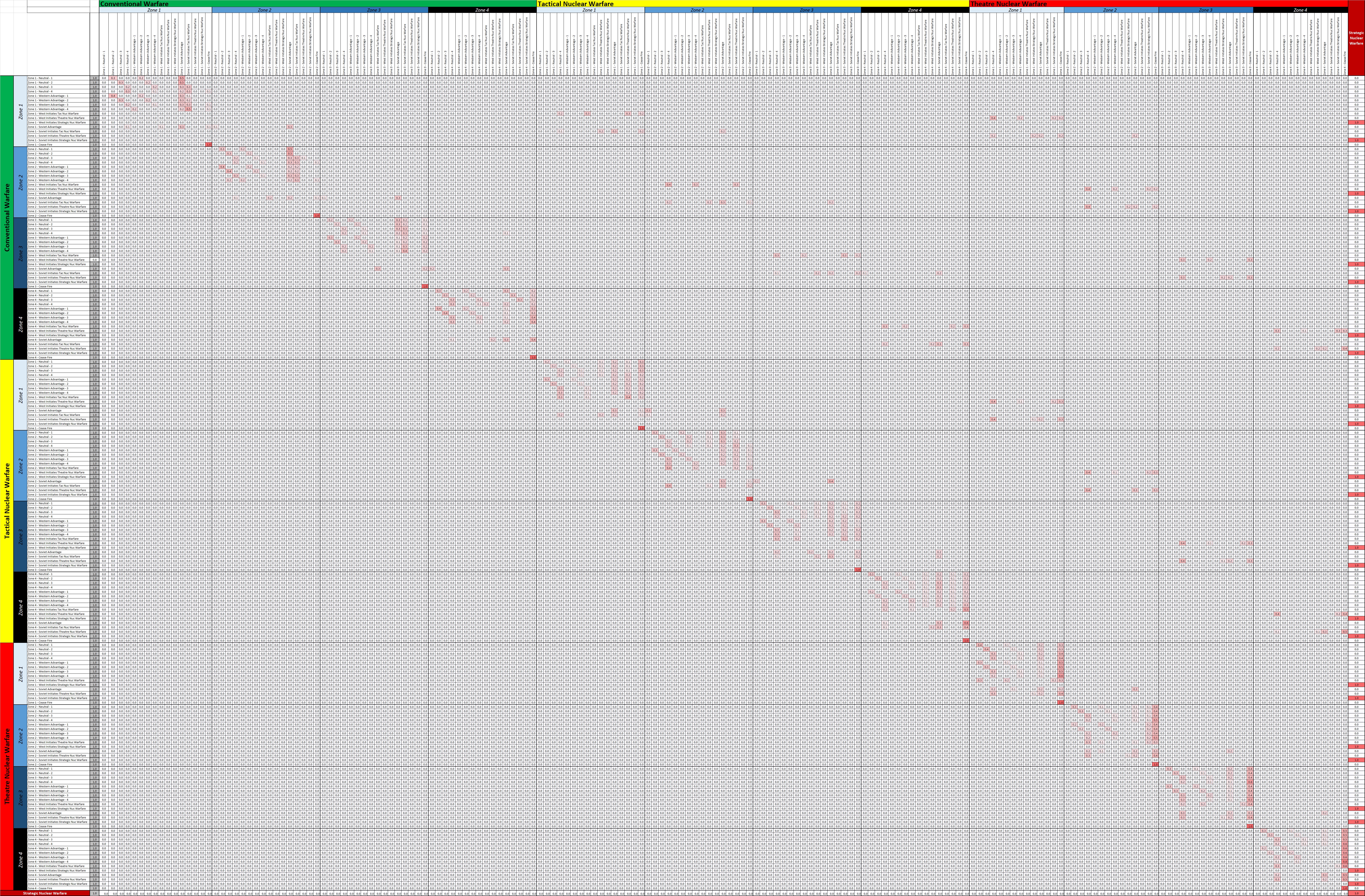
The progress on land was abstracted into 4 zones. In each zone, you can have a state of Western, Soviet or neutral advantage in that zone. There are superstates for Conventional, Tactical and Theatre nuclear warfare where the armies continue to contend. There are also states for cease fires. The general pattern is that if the Soviets do not make enough progress, they begin to entertain escalation to tactical and then theatre nuclear weapons use. The West also has the option of escalation, with the aim of war termination (nuclear combat slows Soviet progress, and makes cease fires more likely in subsequent rounds). As the Soviets make it further, cease fires become more likely than escalation (they figure they have achieved enough of their aims to not have to risk it all with escalation).
A 1D10 is rolled at the beginning of each turn to determine the state for the turn. For the first turn only, instead of the matrix, the players roll 1D10 against the following outcomes to determine the initial state (‘0’ being a 10):
1-3: Zone 1 Conventional Neutral 1
4-9: Zone 1 Soviet Advantage
10: Zone 1 Western Advantage 1
The transition roll for the ground campaign is performed once per turn before the Conflict Level Determination Phase (i.e. do it first in the Turn Sequence).
Escalation is handled as per the original rules, but I’ll discourage nuclear escalation by a player if their side is doing well on land. Also if land had escalated to nuclear use (tactical, operational or strategic), then the players are not penalized with victory point loss for escalating at sea per 17.44.
I added a house rule that escalating to tactical nuclear use cost 40 VPs. This triggers the “West/Soviet Initiated Tactical Nuc Warfare” result on the ground transition matrix.
I added a house rule that on turns where the Soviets managed to interdict any of the major trans-Atlantic SLOCs (i.e. A, B or D) then the Soviet player automatically gets the most advantageous transition matrix result from the current state on the turn after next (warfighting material takes time to get to the front via ship, so the bite is felt 1 game turn after – about 4 days real time).
The game ends upon a either a Cease Fire result (from my matrix) or strategic nuclear exchange (per rule 19.2). Therefore, the sea game does not determine when the game ends by itself.
The assumption made in my scenario (the 1989 scenario) is that the soviets initiate the conflict on very short notice in order to catch the western navies off position. The free world naval positions the first few turns allow the Soviets a window of opportunity to interdict SLOC via air, and to prepare their bastions via mining. Also, it seems to have much of a chance on the central front, the Soviets need all the surprise they can get.
Victory Points (17.0)
Primary Free-World Aims [Breemer, pg. 136]
- The destruction of the Soviet Navy, the US Navy’s only competitor of consequence on the world’s oceans
- Force the Soviet Union to divert military forces that otherwise face the Allies on the Central Front
- Prevent the Soviets from dispatching their attack submarine fleet against the allied SLOCs
- Change the correlation of strategic nuclear forces to the allied advantage, thereby making prolongation of the war increasingly risky for the Soviet Union
Primary Soviet Aims [NWP 11, pg. 119]
- To deploy and provide “combat stability” (that is, protection and support) for ballistic missile submarines in preparation for and conduct of strategic and theatre nuclear strikes.
- To defend the USSR and its allies from enemy sea-based strike forces
- To support ground force operations in the land theatres of military operations, including protecting Pact sea lines of communication and preventing naval support to enemy operations in peripheral areas such as Norway
- To conduct some interdiction of enemy SLOCs
For the most part, the Victory Point schedule reflects the respective aims of the protagonists, but I made the following tweaks.
17.44 Escalation
As mentioned before, if the ground transition matrix escalates to nuclear use then the sea players may escalate up to that level without penalty (e.g. if the Ground transitions to Theatre Nuc use, then players may escalate up to that level with no victory point penalty).
Free World Carrier Strike Posture
To reflect the capability of CVBGs to influence events on land (as the Allies planned and Soviets feared), the Free World player earns 5VPs for each turn for each US or French CV in an Eastern target hex. This also reflects the ability of Free World forces to project power ashore in the form of Amphibious forces (in addition to air strikes) which would draw Soviet forces away from other theatres.
Other House Rules
7.0 Localization
I think there is a problem with the localization rules of Submarines in that it is too easy to find subs. In effect, submarine attacks are almost suicidal in the original rules, which is clearly not in accord with contemporary concepts for submarine operations. For instance, the US Maritime Strategy features submarine operations in well-defended Soviet waters which would be most unwise given the original rules of this game. The sortie of the British SSN HMS Conqueror versus an Argentine task group in the Falklands war (in which the SSN sank the Argentine Cruiser General Belgrano) would have been highly inadvisable in the original rules. Accordingly, I made the following change:
7.2 (Localization) Procedure – Modifications for Submarine Localization
To attack a submarine (phasing or non-phasing – Phasing Submarines are no longer automatically localized) it must be localized. Once a submarine is localized, it remains localized for the remainder of the Combat Sequence of that Turn.
Surface Forces attempting to Localize Submarines
Localization attempts against submarines (non-phasing) is performed each AS combat round the non-phasing sub participates in AS Combat (all submarines may elect to not perform in AS Combat).
Localization may be attempted by Surface Forces during the Submarine Localization phase. Phasing Surface Forces may pool their EW values, while phasing submarines may not. Phasing submarines may attempt localization individually.
Localization is attempted on each submarine individually. Surface forces may add their EW values together in localization (and with air). All forces (surface forces as a group, submarines individually) then attempt localization on each enemy sub individually either as the submarine participates during AS combat or during the Submarine Localization Segment.
Surface Forces attempting localization sum their EW values divide by the EW value of the target sub of the localization attempt (using any applicable EW modifiers ). In cases where the localization target participated in SA combat, round fraction up, otherwise round fraction down) use 1D10 on the table below:
| Surface EW to Sub EW Ratio | Chance of Detection |
| 5 to 1 or above | 80% |
| 4 to 1 | 70% |
| 3 to 1 | 60% |
| 2 to 1 | 50% |
| 1 to 1 | 40% |
| less than 1 | 20% |
Submarines attempting to localize other submarines do this as described in the rules, except that localization attempts may be performed if the target sub engages in SA combat or during submarine localization as described for surface forces above. Submarines must attempt localization individually against individual submarines (i.e. may not pool EW values).
13.0 Mine Operations
I am playing this game solitaire (alas, as most wargames are played), and since mine placement is secret in the original rules, I use the following house rule to make the game more solitaire friendly.
Mines are placed/removed as in the original rules (albeit with a mine marker which I made), but now mine combat is performed on any enemy vessels which move in the hex of the mine marker or any adjacent hex. During the movement phase, the phasing player rolls 2D6 and adds the current mine level as a modifier for each affected hex in the movement. On a 10 or greater, the phasing player must stop in the current hex and suffer the effects of mine combat. On any other roll, the phasing player may continue movement.
14.0 Satellite Operations
Another thing I really like about this game is the explicit treatment of Space operations in the game. Both players must carefully manage Communications, Reconnaissance and Anti-Satellite assets to achieve their aims. However, I think the game is too generous in providing access to space (the original rules have unlimited launches). I made the following change:
At the beginning of the Satellite Operations Segment, the phasing player rolls 1D6 and consults the chart below to determine the number of launches they may attempt this turn:
5 or 6: 2 Launch Attempts this turn
3 or 4: 1 Launch Attempt this turn
1 or 2: 0 No Launch Attempts this turn
The Soviet player may launch any mix of Communications, Reconnaissance and ASATs in a turn, up to the launch number for the turn and as they are available in the inventory.
The Free World player may never launch more than 1 ASAT per turn.
16.12 Aircraft Interdiction (of SLOCs)
The Soviet Player must allocate aircraft for interdiction from designated operative Eastern bases. The player must be able to trace a route from the base to any hex on the interdicted SLOC subject to the aircraft movement restrictions of 6.52.
The Soviet Player may only allocate aircraft for interdiction up to the designated base’s capacity.
16.2 Bases Capture & Inoperative
Disregarding these rules as they seem unrealistic.
16.51 Early Wavering
For turns 1 thru 5, the FW player rolls 1D6 for each nation on this list:
NE, UK, IT, FR and JA – On a roll of ‘1’ that nation negotiates a separate peace and exits the conflict
Western B-52 Strikes
The game short-changes the West in terms of strategic air. While the Soviet player has their Backfires, Badgers, Bears and Blinders fully represented (given that so much of their maritime strength is in aircraft), the Western player has to make due with units mostly representing maritime patrol. In a global conflict, the West would also have use of strategic bombers in conventional roles, namely B-52s flying from forward bases such as Guam, Diego Garcia and the Azores or all the way from Barksdale, Louisiana with aerial refueling if necessary. The capability to reach out and touch Soviet bases via air becomes really important in dealing with Soviet client states off the beaten path, yet in position to interdict vital shipping routes (e.g. Angola, Mozambique, Socotra in the Gulf of Yemen). These out of the way, relatively soft targets are the kinds with could be neutralized in B-52 raids like the Conakry Raid described in General Sir John Hackett’s The Third World War – The Untold Story (pgs. 84-85). In the story the Soviet client state of Guinea host an airfield with the Soviets used as a refueling stop for Soviet bombers interdicting the Atlantic SLOCs. The West elects to take it out with a flight of B-52s out of Barksdale in the first offensive combat mission of the war.
To model this capability, the Western player during the Assign Aircraft segment may roll 1D6 on the following table:
5 or 6: 2 Raids this turn
3 or 4: 1 Raid this turn
1 or 2: 0 No Raids this turn
A B-52 raid may only be done against an Eastern class 3 base in a non-target hex. This restriction models the ability of a Flight or 2 of B-52s being able to but relatively small, lightly defended bases out of commission in a single sortie. More substantial bases would have adequate defenses to make more sustained efforts necessary. A raid, makes the base inop for the remainder of the game.
The Western Player loses the ability to carry out these strikes at Conflict Level 4 (theatre nuclear war).
Pimp my Game
There are a few things that the game needs to be playable, in my opinion.
Markers and Play Aids
This game definitely skimped on markers. Aircraft should have “currency” markers so you can allocate them to battles around the board. Originally, you were supposed to write down what aircraft are going where, but that is an accounting nightmare, especially during battles. I Also added other markers for game turn (front: Soviet, back: Free World), mine markers (per my solitaire rule) and some others.
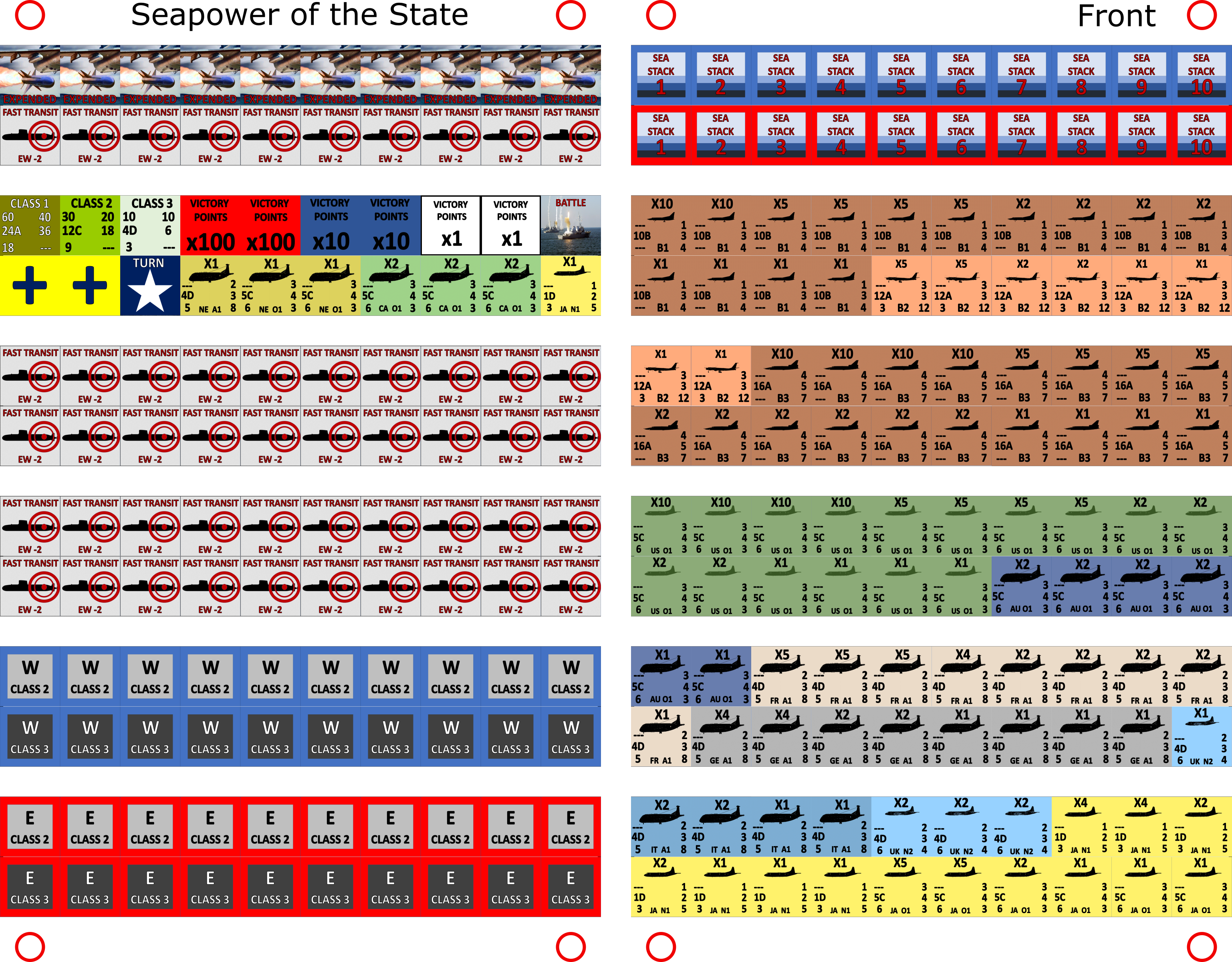
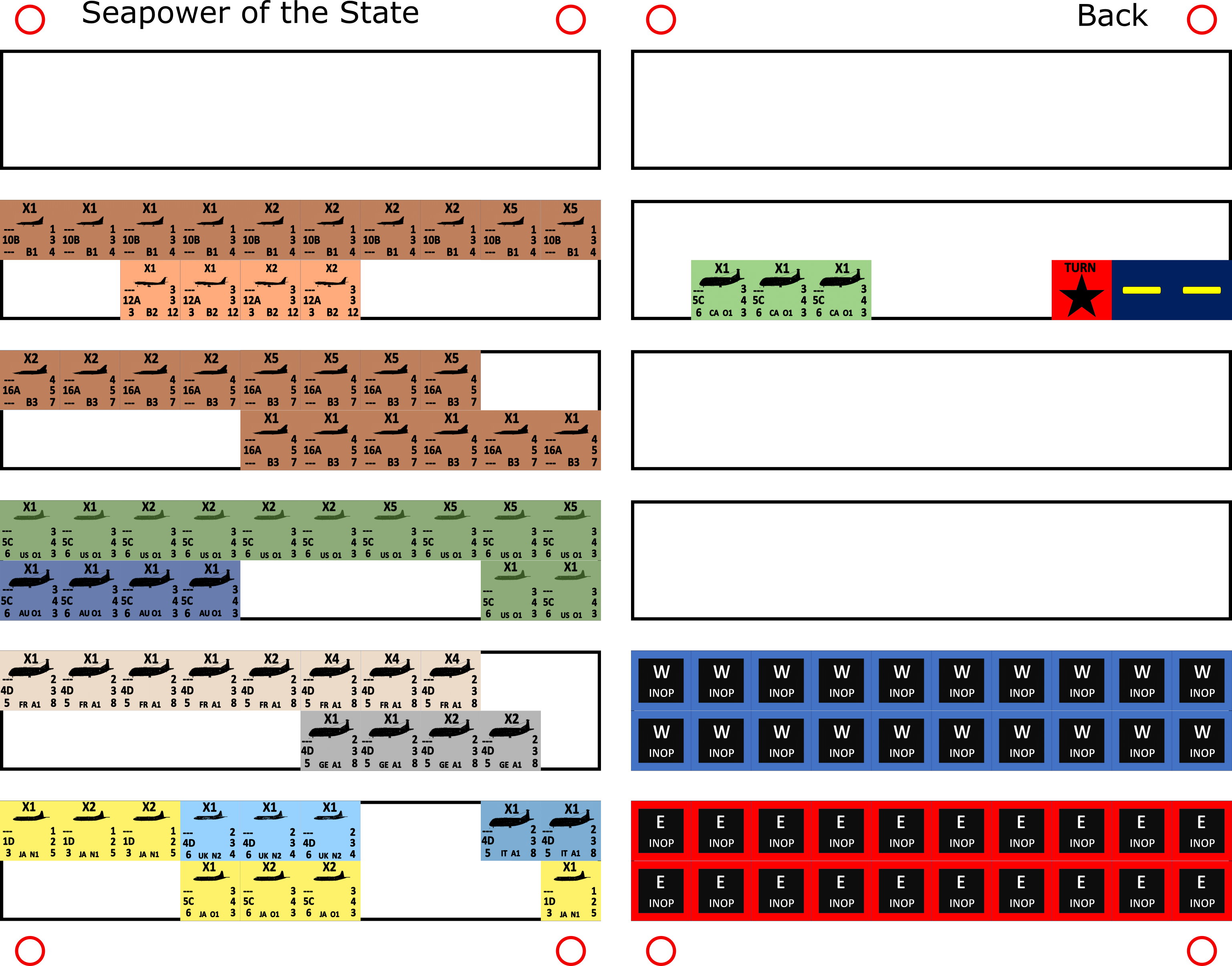
The most important markers you need are Stack markers (along with stack sheets to hold the unit counters of the stacks). The game involves some horrible stacks, especially around Europe (imagine teetering stacks of a dozen units!). I’ve included stack boards for each side, along with victory point tracks (victory point markers included as well – ones, tens, hundreds and positive/negative).
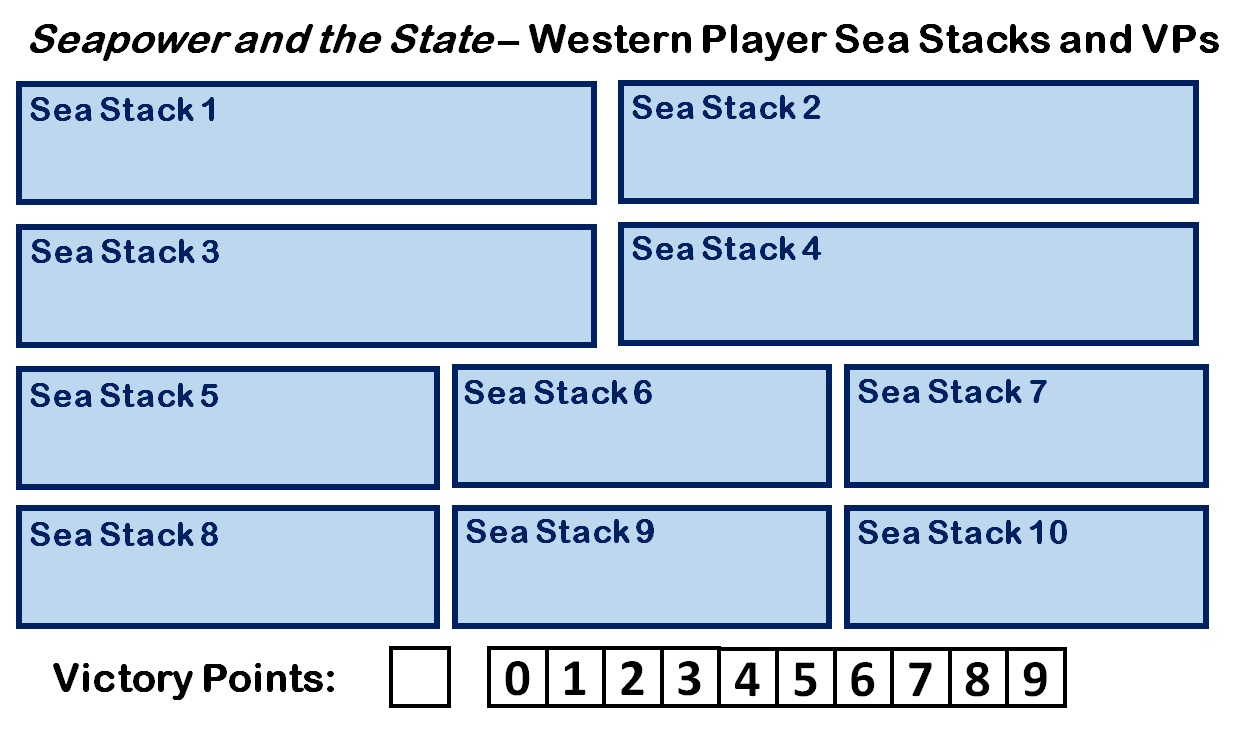
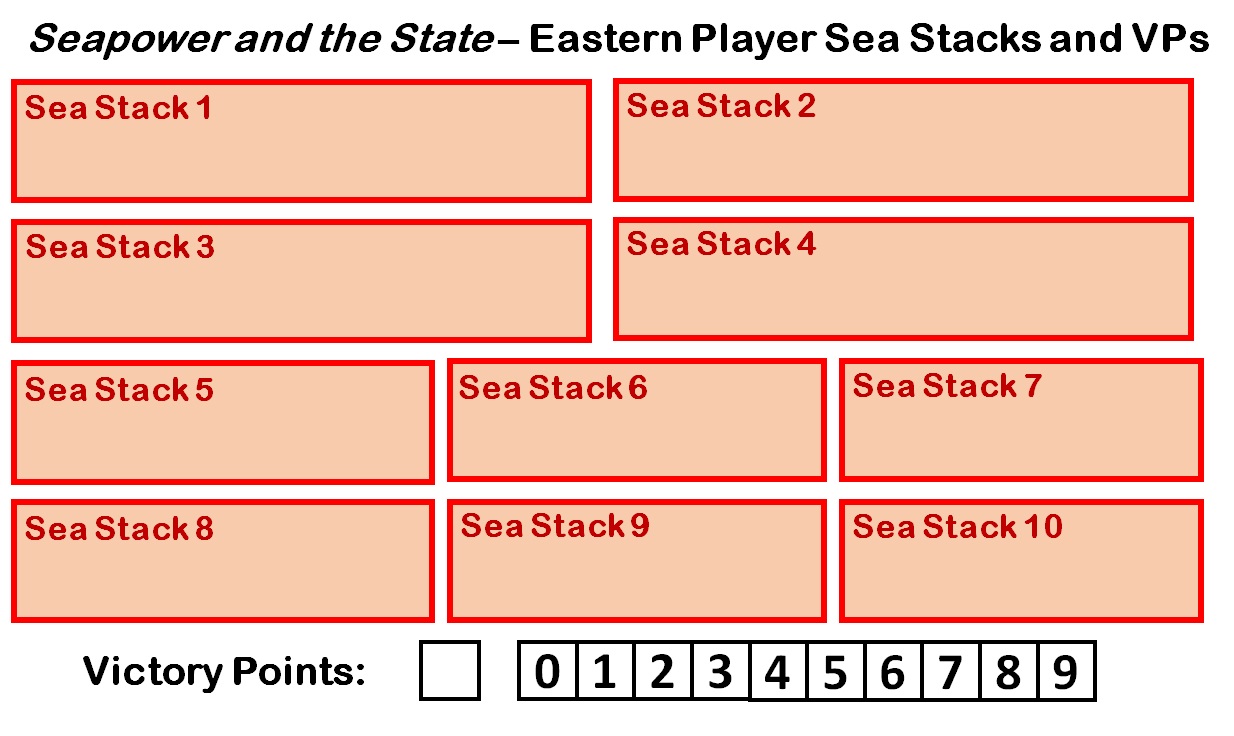
Other nice marker adds are “AS Fired” markers for aircraft on the battle board and fast transit (7.35) markers to denote submarines which are noisier due to fast speeds.
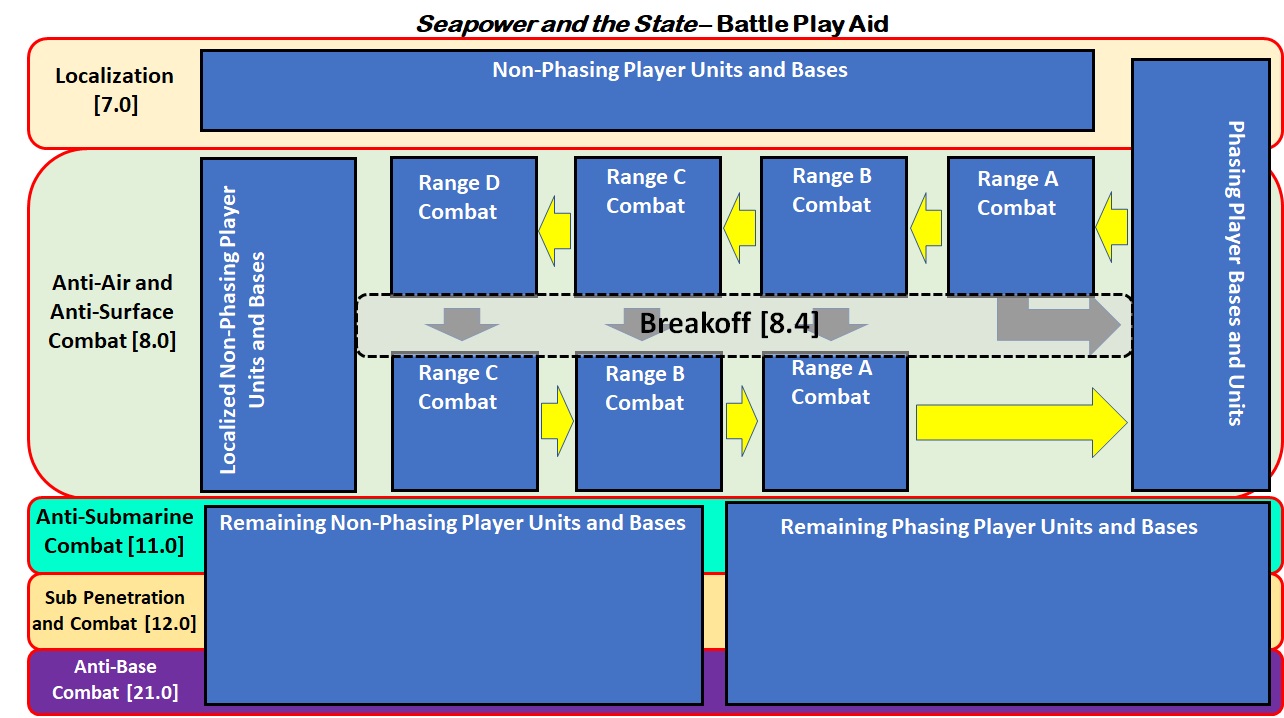
The battle board steps players through the combat sequence and gives them a place to put the participating units.
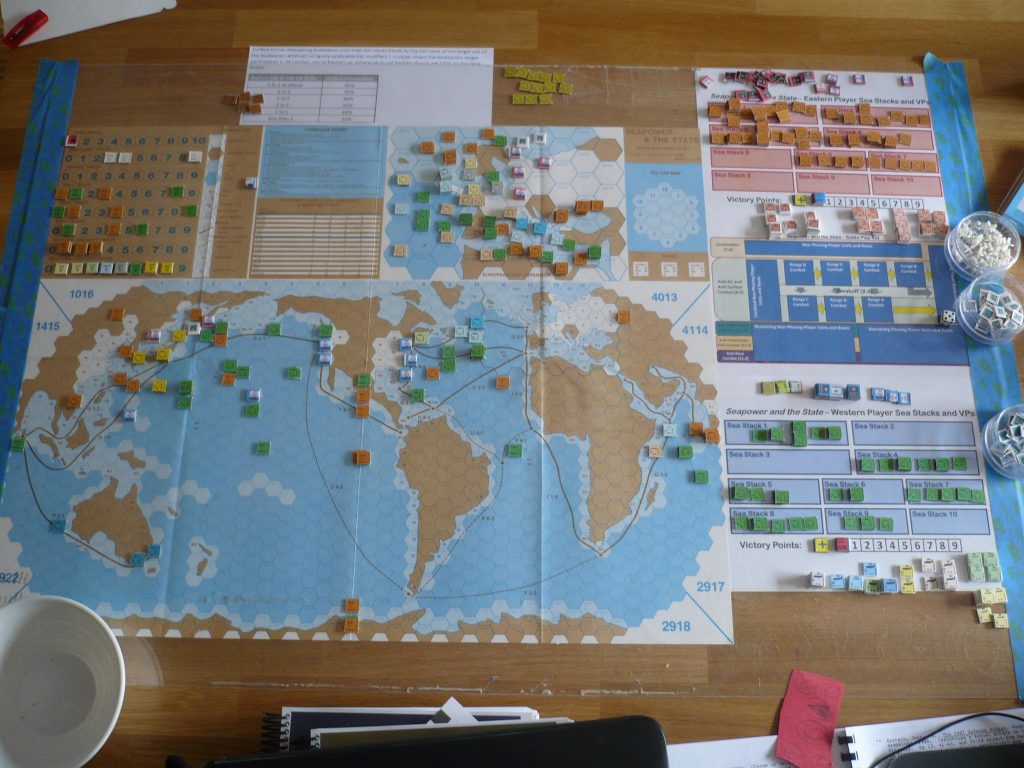
A sign of a great game is that you enjoy just having it set up to look at; bask in the contest to be simulated as a system of related concerns that fits on your table!
In part 2 of this post, I will go over how I’ll play the respective sides in each theatre based on the Maritime Strategy and contemporary Intelligence estimates of Soviet Capabilities and intentions.
References
[NPT 33] Naval War College Newport Papers 33 – U.S. Naval Strategy in the 1980s (selected documents), John B. Hattendorf, Peter M. Swartz, editors. Naval War College Press, Newport (2008)
[NPT 19] Naval War College Newport Papers 19 – The Evolution of the U.S. Navy’s Maritime Strategy, 1977-1986, John B. Hattendorf, editor. Naval War College Press, Newport (2004)
Newberg, Stephen. “Seapower and The State – A Strategic Study of World War Three at Sea, 1984-1994”. Simulations Canada, 1982
[Breemer] Breemer, Jan. Soviet Submarines – Design, Development and Tactics. Janes Information Group (1989)
Criticisms of the Maritime Strategy can be found in Peter Swartz’s The Maritime Strategy Debates: A guide to the renaissance of U.S. naval strategic thinking in the 1980s (Naval Postgraduate Schoool – 1988). The criticism most salient to my concerns (the potential for nuclear combat and escalatory concerns of the strategy) can be found in the Swartz bibliography (cited here):
Polmar, Norman, “The Soviet Navy: Nuclear War at Sea”, Proceedings, July 1986, pp 111-113. (“The Maritime Strategy must be challenged for its lack of definition in how we are to deter nuclear war at sea”)
A description of the Conakry B-52 raid:
Hackett, Gen. Sir John, The Third World War – The Untold Story, Sidgwick and Jackson, London, 1982