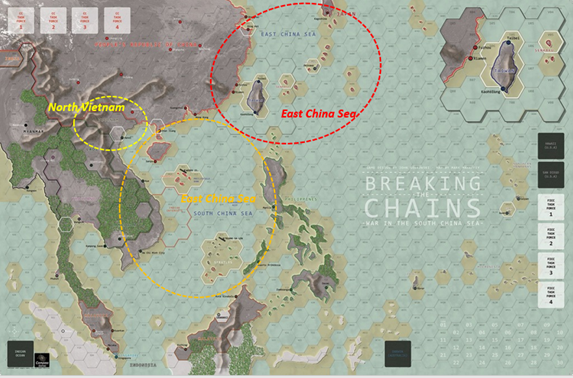
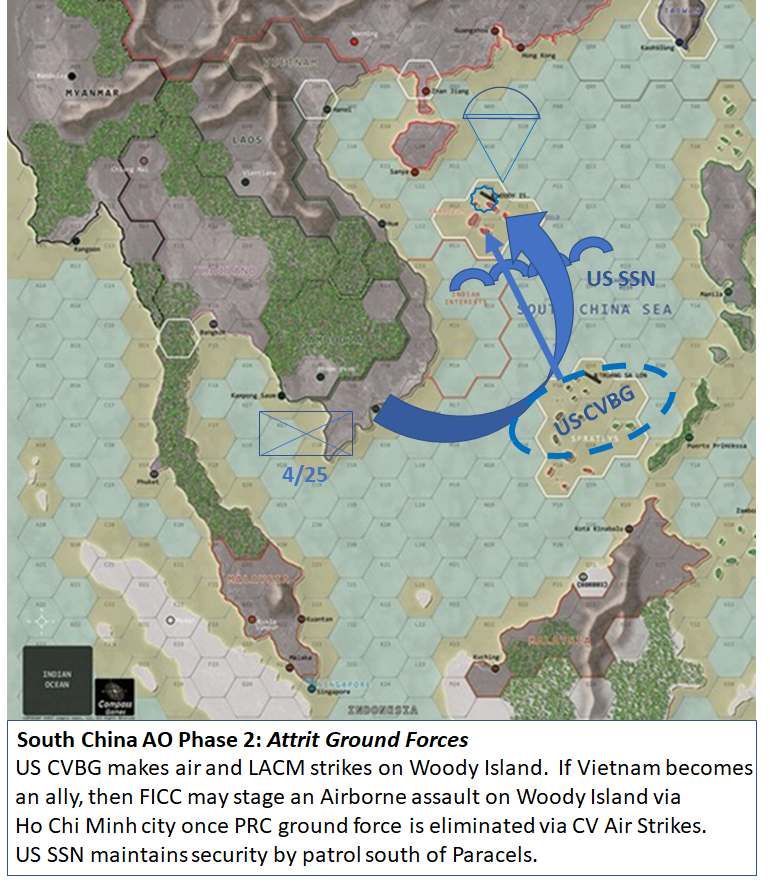
Back in March, I played out a game of Breaking the Chains simulating an invasion of Taiwan by the People’s Republic of China being countered by a coalition led by the United States. My interest was to get an appreciation of the political-military balance between the potential opponents in the context of this worst case scenario. I had made some adjustments and house rules to include important factors that the original game missed:
- Adding PRC Ballistic Missile attacks on Installations, Troops
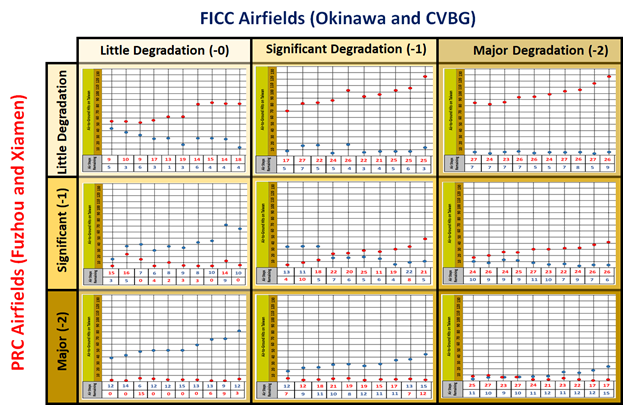
- Modeling Airfield Degradation/Repair
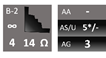
- Added US B-2 bombers to the FICC order-of-battle
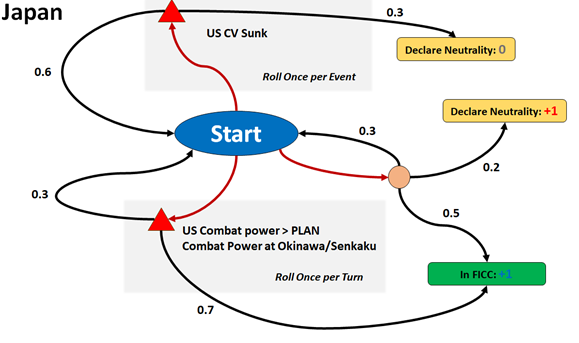
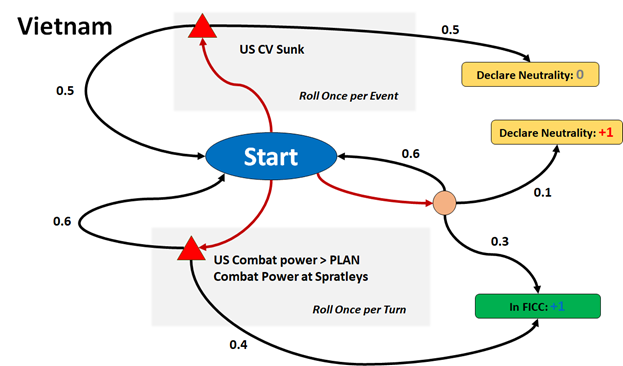
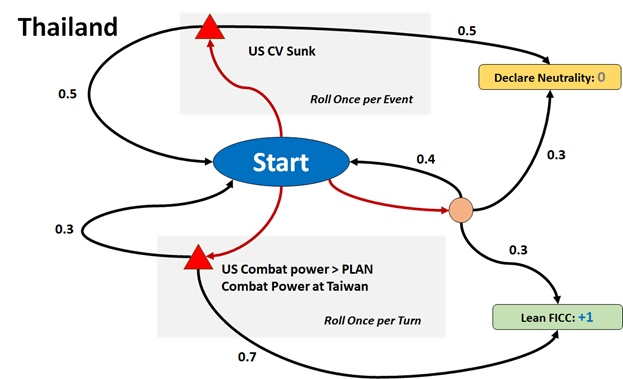
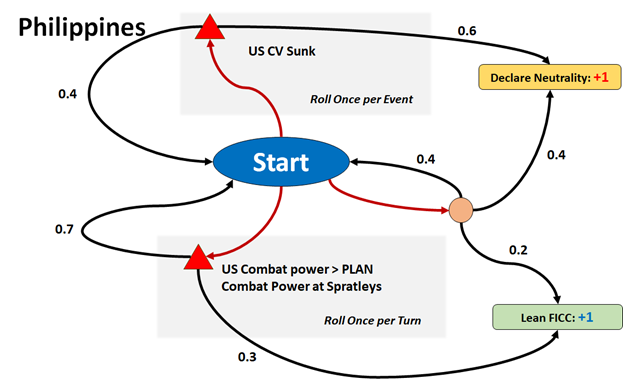
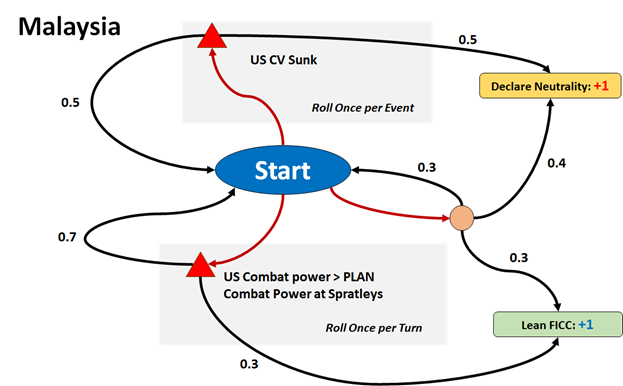
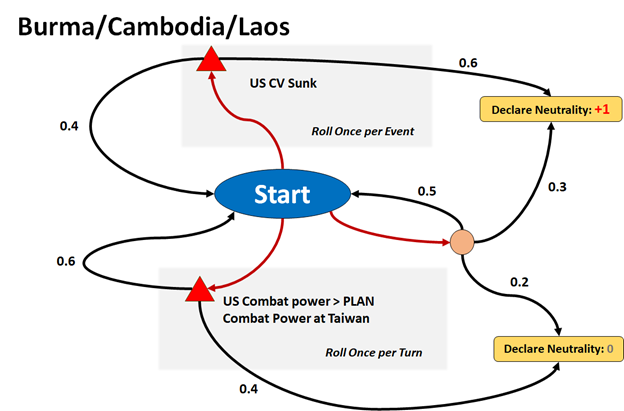
- Included a more involved political model conditioning alignments of regional actors on game events
I wrote an appreciation of the situation and selected courses of action for both the PRC and the US-lead First Island Chain Coalition (FICC).
The bad news was that the FICC lost decisively in the first four days with Taiwan being overrun by PRC troops. The good news is that many of the deficiencies in the FICC military capabilities leading to the loss are being addressed. I cover a few of these, and most humbly float my own observations based on what I saw.
A Caveat
It has been stated by many others, and I too will say this more than once that wargames are not crystal balls. A wargame result, no matter how one-sided is never a prediction. Each game is a non-repeatable exploration using a set of assumptions in a specific context. Properly executed, a wargame can provide to insights and pertinent questions to be answered through analysis and real-world exercises.
I’d like to follow up with a play of Next War: Taiwan, which has a more precise treatment of the air and ground struggle on the island itself to understand just how the central battle of this campaign could play out and the factor involved. The operational, theatre-level treatment offered by Breaking the Chains gave good context for follow-up questions to answer with other games and analyses.
PRC Course of Action
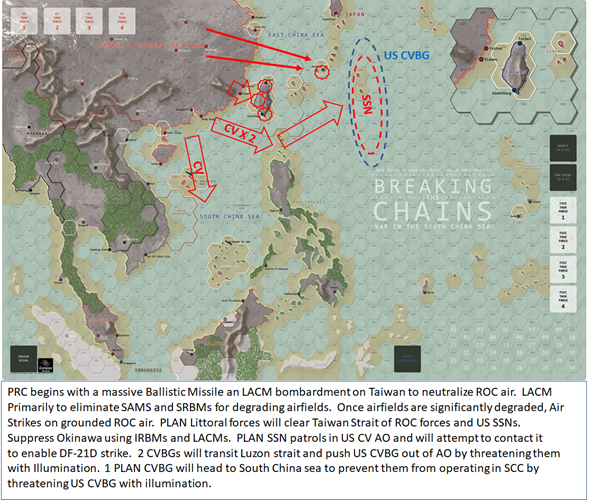
The PRC Course of Action was designed to establish PRC dominance of the Taiwan strait and the airspace over Taiwan as soon as possible in order to ensure the safe transport of the PRC amphibious forces to the island as soon as practical. The time pressure on the PRC was to take advantage of the FICC window of vulnerability where the FICC was awaiting additional carriers to augment the one Carrier Battle Group on Station.
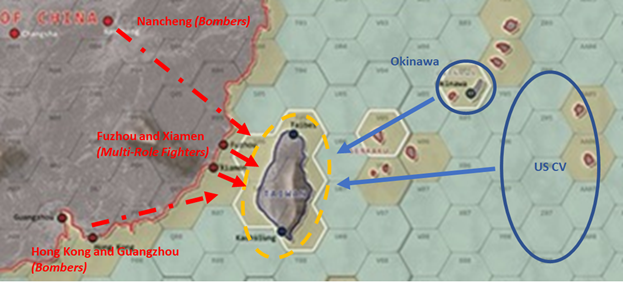
The PRC began with a massive ballistic and cruise missile attack on airfields on Taiwan and Okinawa to ground the ROC and US Air Forces that would contest for the airspace over the island of Taiwan. Taiwanese airfields were mostly hit using short range ballistic missiles (DF-11 & 15), while the US airfield on Okinawa was hit with medium range ballistic missiles (DF-21C). Defending SAMs were hit using cruise missiles.
What was the FICC trying to do?
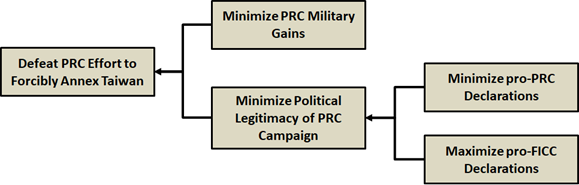
In my estimation, I had posited that the FICC primary objective was to Defeat the PRC Effort to Forcibly Annex Taiwan. This objective was further decomposed into military and political branches of supporting objectives. The political branch was addressed in the game by an enhanced political model which conditioned the probability of potential regional allies joining the respective coalitions to events on the board. The game played did not last long enough (4 days) for much to have happened on the political front, so I will not have much to say on that in this post.

The Operational Plan I used for the FICC had a set of Functions (yellow rectangles above) to realize the FICC Objectives identified (grey boxes). To analyze the FICC failure to achieve their military objectives, I address the shortcomings of the FICC which impacted its ability to carry out the top set of functions realizing the military objective Minimize PRC Military Gains.
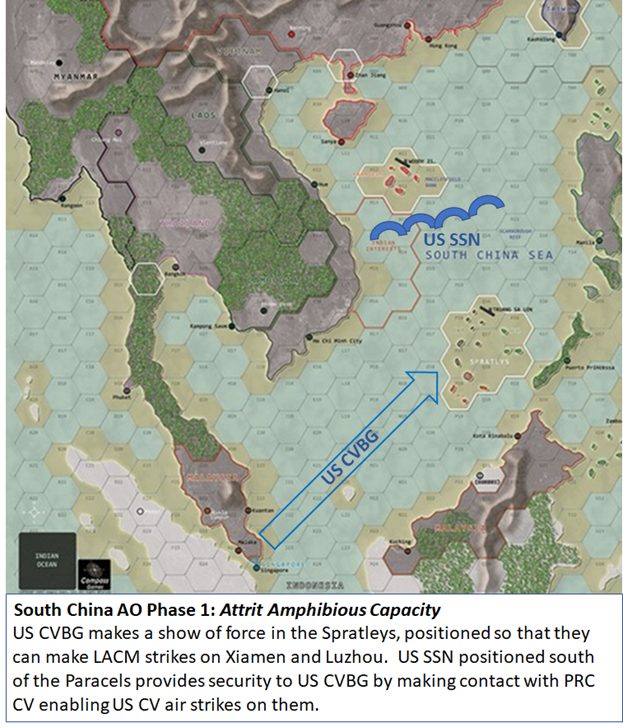
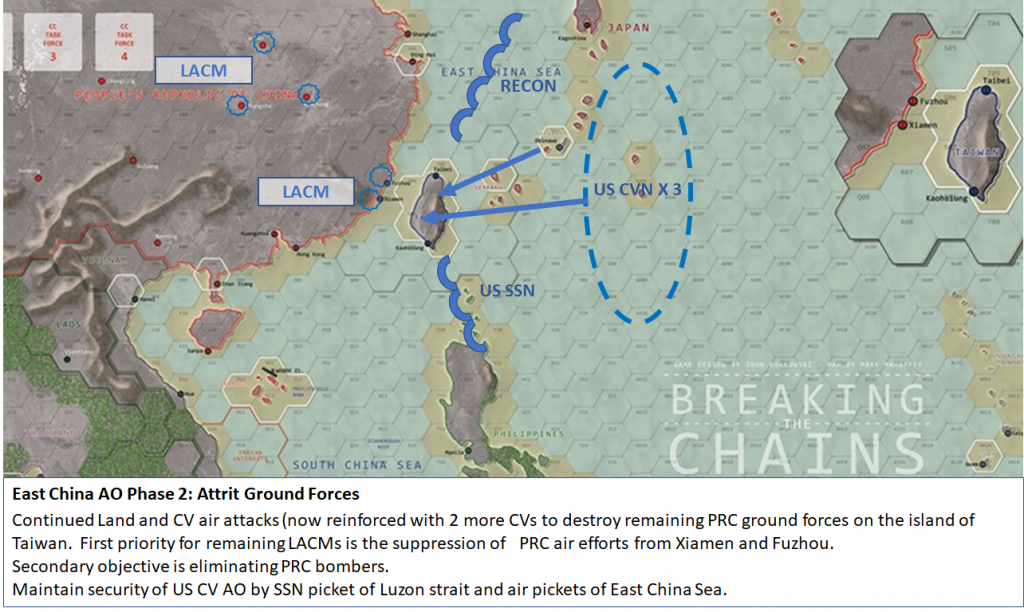
The FICC operational plan was broken into two phases; Attrit Amphibious Capacity and Attrit Ground Forces. Each of these phases correspond to the PRC operational centers of gravity being the Amphibious Transports and Landed Ground Forces respectively. As the PRC achieved decisive victory on day 4, this analysis will focus on phase 1 Attrit Amphibious Capacity only.

The FICC plan in phase 1 was to destroy as many of the PRC amphibious transports as possible. By doing so, the PRC would be permanently deprived of the ability to convey troops to Taiwan and achieve their objective of overrunning the island. PRC airborne forces alone were assessed as insufficient to take the island by themselves. The PRC amphibious transports were to be destroyed by a combination of FICC Air (primarily ROC Air Force and US air from Okinawa and US CVBG) as well as US SSNs patrolling the Taiwan strait.
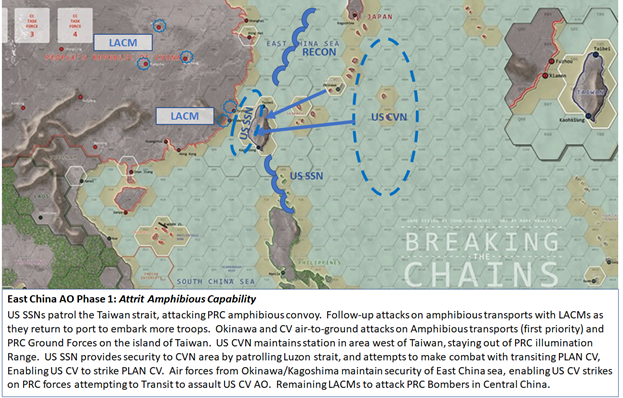
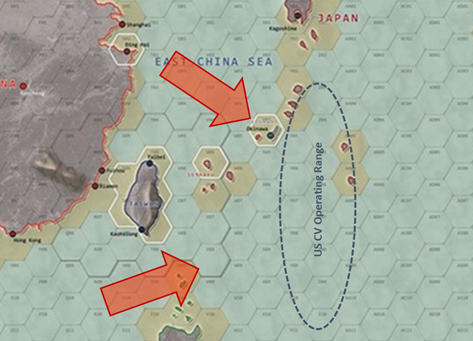
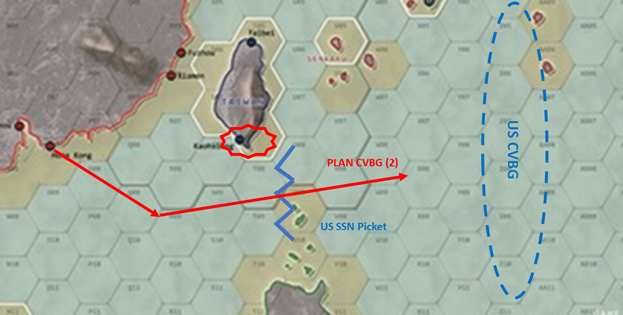
The US CVBG was to patrol to the eastt of Taiwan in an area beyond the range of PRC reconnaissance. A key constraint was that the US carrier could not be allowed to be targeted by the PRC for DF-21 anti-ship ballistic missile (ASBM) strikes. While this area was outside reconnaissance range from PRC land-based air, the USN would have to also take measures to protect this area from PLAN carriers, and from the PLA(N) SSN patrolling the area. If the PLA(N) could get a fix on the US carrier, they could damage or destroy it with unacceptable military and political consequences for the FICC.
The ROC Air Force was mostly out of the fight due to PRC ballistic missile strikes. The PRC started by attacking runways and did enough damage that the ROC air force was largely grounded. The PRC also grounded US air forces in Okinawa using MRBMs. As a result, the PLAAF was largely unopposed in the air over Taiwan, and were able to make precision air-to-ground attacks on the ROC Navy (most of their navy was sunk from the air), SAMs and the grounded ROC Air Force. While the distance from the Chinese mainland to Okinawa meant a lower PRC sortie rate, the PRC was also able to greatly reduce US airpower in Okinawa using the same tactic.
With the ROC and US air forces on Okinawa mostly grounded and slowly destroyed in their hardened shelters by precision air-to-ground and cruise missile strikes, FICC air over Taiwan depended on the CVBG. The CVBG in its safe area was too far from Taiwan to be much more than an “air force in being”; able to threaten PRC amphibious assaults but not contest for air superiority.
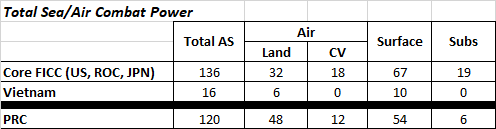
Unfortunately, the PLA(N) was able to dislodge the US CVBG from its safe area. The PLA(N) had detailed two of its three CVBGs to force the Luzon strait in order to bring the Chinese carriers within reconnaissance range of the US carrier. Unfortunately for the FICC, the PLA(N) superiority in surface forces (Sovremenny DDGs outnumbering and outranging the US Burke DDGs) won the battle for the Luzon strait for the PLA(N). As a result, the US CVBG had to retreat to the east, leaving the PRC in complete control of Taiwan airspace.
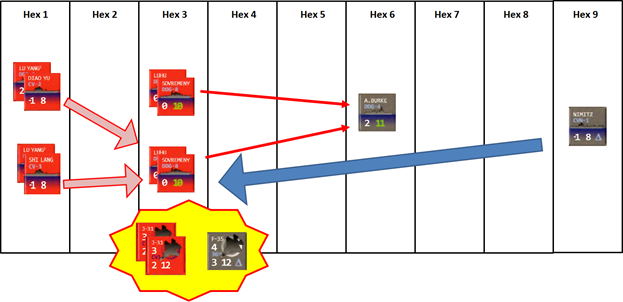
With Air Superiority over Taiwan secured and most of the Taiwanese navy either sunk or huddling out of the way under the cover of the remaining SAMs, the PRC then had their amphibious convoy set sail for Taiwan attended by a sizable ASW presence. The only remaining US remaining to bear were the US SSNs waiting in ambush in the Taiwan Strait. While the US Boats managed to sink a few transports, enough were able to get through to the island and establish a beachhead that the ROC Army could not dislodge.
Attrit PRC Ground Forces
With ROC Air Force and US air driven from Taiwan airspace, the only FICC force which could carry out the PRC ground force attrition function was the Taiwanese army. Unfortunately, the Taiwanese army was significantly degraded by this point due to unremitting PRC SRBM strikes and precision air-to-ground strikes by an unfettered PLA Air Force. The model of SRBM strikes I used may have been too generous to the PRC, but I think it is a fair assessment that hundreds of SRBMs loaded with cluster munitions would have a significant impact on defending troops.
Degrade PRC Air Capacity
With a significant PRC amphibious presence on the island, the FICC needed to degrade PRC air capacity over the island in order to keep the balance from tipping too steeply against the ROC Army in the land battle. Due to the processes described above, the FICC was not able to mount significant Combat Air Patrols (CAPs) by the Taiwanese Air Force or Air Superiority Sweeps by the US air units. To degrade PRC air over Taiwan, the FICC needed to depend on cruise missiles to attack key PRC airfields hosting the PLAAF units pounding Taiwan. While some degradation was achieved by the US LACM strikes (launched from in-theatre US DDGs, SSNs), the effects were not enough to significantly degrade the ability of the PLAAF to launch sorties against the island. B-2 strikes were attempted, with few results (not enough B-2s available to make much of a dent).
How could the FICC have Done Better?
I had not expected the FICC effort to crumble so soon, but looking at the designer notes, he had mentioned that players could expect Taiwan to fall quickly if the PRC player chose to make conquering that island their focus. Given that Taiwan has maintained its independence this long, I suspect that a successful, quick cross-strait invasion is not that forgone a conclusion. I plan on playing an even more detailed game that focuses on the battle in and over Taiwan (Next War: Taiwan) to explore this further. Breaking the Chains was a good start for a theatre-level military-political simulation which will provide context for the more focused simulation offered by Next War: Taiwan.
So, before I give my “make better” assessments, a few more caveats. I acknowledge “garbage in, garbage out”; that my assesments can only as good as my inputs (see the references list below). All sources are unclassified. The game I used is primarily designed for playability by civilians. And finally, I am sure there are perfectly valid military/political/economic considerations that I am not fully aware of that help to explain why the FICC forces are structured as they are. My assessments should in no way be considered “advice”, but it will be interesting to see where folks in responsible positions make changes congruent with what I put here (imagine me with a “Bingo Card” marking where measures I suggest were taken).
All that being said, my fixes come in 2 categories; (relatively) Easy Fixes and Hard Fixes. The “make betters” I put forward are limited to enhance the FICC functions of Reduce PRC Amphibious Capacity, Attrit PRC Ground Forces and Degrade PRC Air Capacity
(Relatively) Easy Fixes
Additional US Carrier on Station at Start of Hostilities
The PLA(N) achieved a “mission kill” of the US carrier by forcing the Luzon Strait and compelling the CVBG to withdraw further to the east in order to avoid detection by the Chinese carriers and possible ensuing destruction by ASBMs. The PLA(N) succeeded in this primarily due to having 2 CVBGs vs the one of the US. Despite US qualitative air superiority, the US could not succeed against the combined PLA(N) naval aviation. The superior PLA(N) surface forces pushed the US Burke DDG pickets back on the CVBG, compelling the US Force to withdraw. Two US Carriers on station at the onset of hostilities would have made all the difference, winning the battle of the Luzon strait and keeping US air in the fight over Taiwan. The possibility of US air available for anti-shipping operations over the Taiwan strait could have been enough to keep the PRC amphibious convoy from sailing for the island.
Fortunately, the US is beginning to up patrols of carriers in the Indo-Pacific recently with three in the pacific for the first time in years. Such a move should positively impact stability and reassure regional allies of US resolve.
Hold PRC Airbases at Risk
The US operational plan required a substantial degradation in PRC ability to put sorties over Taiwan. If the PRC gained air superiority, they would be able to clear the Taiwan strait of the ROC navy, finish the ROC air force grounded by SRBM strikes and to drive the ROC Army away from the planned beachheads. Even with the US and ROC regional land-based air grounded, degraded PRC airfields would have slowed these processes and possibly bought enough time for US reinforcements to stabilize the situation. Since FICC air was unable to do this for the reasons already given, US LACMs launched from DDGs and SSNs in the area had to take up the slack. Unfortunately, there were not enough of these to have much effect. An encouraging development is the refitting of 4 Ohio-Class SSBNs to Tomahawk LACMs. Each of these would be able to launch salvoes of up to 144 cruise missiles from their vertical launch tubes. With these on station, the US could have trickled out enough cruise missiles to hit the most important PRC airfields and relieve pressure on the Taiwanese defenders until more substantial aid could arrive.
The B-2s I added to the game were welcome, but there were too few of them to make a difference. B-2s would be employed most sparingly to hit the highest value targets.
Hard Fixes
Restructuring ROC Air and Naval Forces
In my opinion, judging from the order of battle of the ROC forces in the game and literature – Taiwan may have the wrong force makeup to resist a cross-strait invasion. First, the PRC has SRBMs… lots of them… hundreds verging on thousands pointing at the island. While accuracy may vary, you do not need to be very accurate to punch holes in runways and scatter cluster munitions. SRBMs will shut down the ROC airbases, and then the Taiwanese Air Force will be grounded. Grounded, they are out of the fight and will be destroyed while the PLAAF has free run of the skies. Contesting for air superiority may be beyond the ROC Air Force due to the numerical imbalance, but the good news is that you do not need air superiority to strike critical blows – you just need to be able to fly. This is especially true in Taiwan’s case, as the Chinese Center-of-Gravity in the early phase of this scenario is slow, vulnerable amphibious transports. To fly and do what matters, I suggest the ROC employ air forces employ aircraft using Vertical Take Off and Landing (VTOL) from dispersed, impromptu sites around the island. Much like the original CONOPS of the AV-8 Harrier for operating in the Central European theatre against the Warsaw Pact, ROC VTOL aircraft (such as the VTOL variant of the F-35) would be able to carry out missions in support of ground forces and remain available for the all-important interdiction strikes against the PRC amphibious convoy. While VTOL mean much lighter loads in weapons and fuel (hence shorter range), you don’t have to have too much lift capacity to carry a couple of Air-to-Surface missiles and a couple of Air-to-Air missiles for self-defense. As for range, the aircraft would not need much as they would be operating in hit-and-run attacks over the island and the adjacent strait.
The ROC navy seems like it is structured to be a sea-control force on the cheap. Unfortunately, given the assumption of PRC air superiority given the reasons above, the too few destroyers and frigates of the ROC navy just offer a set of targets for the PLAAF. In my game, the ROC navy barely got into action. Sea control, even locally, may be beyond Taiwan vis-à-vis China. What Taiwan may consider is an enhanced sea-denial navy; denying China a means to cross the strait long enough for help to arrive. Scrap the Destroyers and Frigates in favor of networked swarms of small, Fast stealthy surface forces equipped with anti-ship missiles and diesel submarines. Sure this navy will not help Taiwan maintain their claims on rocks in the South China Sea, but the idea that Taiwan would risk providing the PRC with a cause to use force over such claims in far-fetched.
Lastly, the ROC army should be ready to use maximum mobility as a means to avoid being targeted and hit by PRC SRBMs. The best way to beat a missile is to not be where it is going, and by staying on the move (employing roads off the beaten path and making an additional network of dirt roads), eschewing permanent fixed fighting positions in favor of impromptu fighting positions, and employing tactics emphasizing hit-and-run and ambush attacks the ROC could mitigate the missile threat and remain viable long enough for the tide to turn in the air when US follow-on forces arrive in theatre.
References:
Eric Heginbotham “The U.S.-China Military Scorecard”, Rand Corporation 2015.
IISS “The Military Balance – the Annual Assessment of Global Military Capabilities and Defense Economics 2020”, Routledge 2020.
Alfred Price “Air Battle Central Europe”, Free Press 1986.