Breaking The Chains: a game post-mortem

Back in March, I played out a game of Breaking the Chains simulating an invasion of Taiwan by the People’s Republic of China being countered by a coalition led by the United States.  My interest was to get an appreciation of the political-military balance between the potential opponents in the context of this worst case scenario.  I had made some adjustments and house rules to include important factors that the original game missed:

  • Adding PRC Ballistic Missile attacks on Installations, Troops
  • Modeling Airfield Degradation/Repair
  • Added US B-2 bombers to the FICC order-of-battle
  • Included a more involved political model conditioning alignments of regional actors on game events

I wrote an appreciation of the situation and selected courses of action for both the PRC and the US-lead First Island Chain Coalition (FICC).

The bad news was that the FICC lost decisively in the first four days with Taiwan being overrun by PRC troops.  The good news is that many of the deficiencies in the FICC military capabilities leading to the loss are being addressed.  I cover a few of these, and most humbly float my own observations based on what I saw.
A Caveat

It has been stated by many others, and I too will say this more than once that wargames are not crystal balls.  A wargame result, no matter how one-sided is never a prediction.  Each game is a non-repeatable exploration using a set of assumptions in a specific context.  Properly executed, a wargame can provide to insights and pertinent questions to be answered through analysis and real-world exercises.

I’d like to follow up with a play of Next War: Taiwan, which has a more precise treatment of the air and ground struggle on the island itself to understand just how the central battle of this campaign could play out and the factor involved.  The operational, theatre-level treatment offered by Breaking the Chains gave good context for follow-up questions to answer with other games and analyses.

PRC Course of Action

The PRC Course of Action was designed to establish PRC dominance of the Taiwan strait and the airspace over Taiwan as soon as possible in order to ensure the safe transport of the PRC amphibious forces to the island as soon as practical.  The time pressure on the PRC was to take advantage of the FICC window of vulnerability where the FICC was awaiting additional carriers to augment the one Carrier Battle Group on Station.

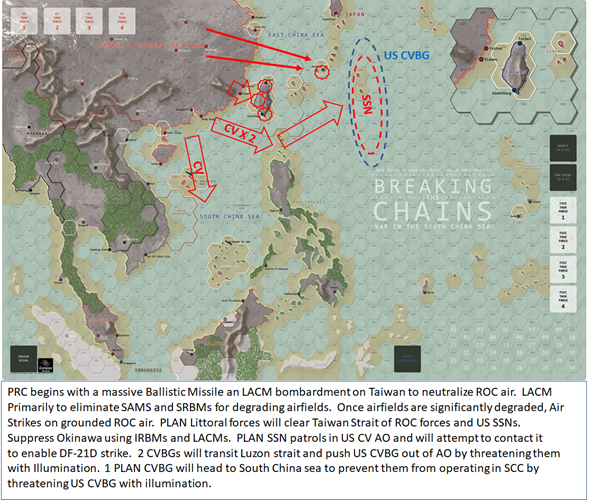
The PRC began with a massive ballistic and cruise missile attack on airfields on Taiwan and Okinawa to ground the ROC and US Air Forces that would contest for the airspace over the island of Taiwan.  Taiwanese airfields were mostly hit using short range ballistic missiles (DF-11 & 15), while the US airfield on Okinawa was hit with medium range ballistic missiles (DF-21C).  Defending SAMs were hit using cruise missiles.
What was the FICC trying to do?

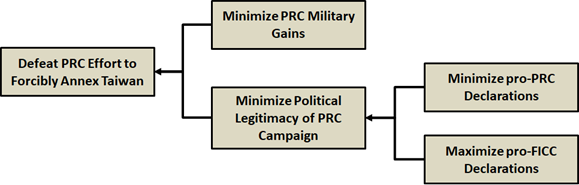
In my estimation, I had posited that the FICC primary objective was to Defeat the PRC Effort to Forcibly Annex Taiwan.  This objective was further decomposed into military and political branches of supporting objectives.  The political branch was addressed in the game by an enhanced political model which conditioned the probability of potential regional allies joining the respective coalitions to events on the board.  The game played did not last long enough (4 days) for much to have happened on the political front, so I will not have much to say on that in this post.

The Operational Plan I used for the FICC had a set of Functions (yellow rectangles above) to realize the FICC Objectives identified (grey boxes).  To analyze the FICC failure to achieve their military objectives, I address the shortcomings of the FICC which impacted its ability to carry out the top set of functions realizing the military objective Minimize PRC Military Gains.

The FICC operational plan was broken into two phases; Attrit Amphibious Capacity and Attrit Ground Forces.  Each of these phases correspond to the PRC operational centers of gravity being the Amphibious Transports and Landed Ground Forces respectively.  As the PRC achieved decisive victory on day 4, this analysis will focus on phase 1 Attrit Amphibious Capacity only.

The FICC plan in phase 1 was to destroy as many of the PRC amphibious transports as possible.  By doing so, the PRC would be permanently deprived of the ability to convey troops to Taiwan and achieve their objective of overrunning the island.  PRC airborne forces alone were assessed as insufficient to take the island by themselves.  The PRC amphibious transports were to be destroyed by a combination of FICC Air (primarily ROC Air Force and US air from Okinawa and US CVBG) as well as US SSNs patrolling the Taiwan strait.
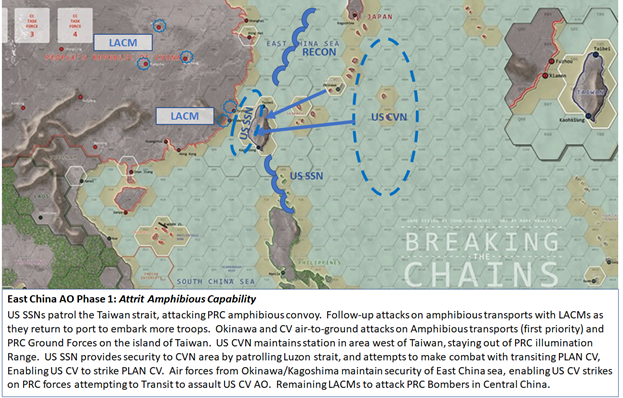
The US CVBG was to patrol to the eastt of Taiwan in an area beyond the range of PRC reconnaissance.  A key constraint was that the US carrier could not be allowed to be targeted by the PRC for DF-21 anti-ship ballistic missile (ASBM) strikes.  While this area was outside reconnaissance range from PRC land-based air, the USN would have to also take measures to protect this area from PLAN carriers, and from the PLA(N) SSN patrolling the area.  If the PLA(N) could get a fix on the US carrier, they could damage or destroy it with unacceptable military and political consequences for the FICC.

The ROC Air Force was mostly out of the fight due to PRC ballistic missile strikes.  The PRC started by attacking runways and did enough damage that the ROC air force was largely grounded.  The PRC also grounded US air forces in Okinawa using MRBMs.  As a result, the PLAAF was largely unopposed in the air over Taiwan, and were able to make precision air-to-ground attacks on the ROC Navy (most of their navy was sunk from the air), SAMs and the grounded ROC Air Force.  While the distance from the Chinese mainland to Okinawa meant a lower PRC sortie rate, the PRC was also able to greatly reduce US airpower in Okinawa using the same tactic.

With the ROC and US air forces on Okinawa mostly grounded and slowly destroyed in their hardened shelters by precision air-to-ground and cruise missile strikes, FICC air over Taiwan depended on the CVBG.  The CVBG in its safe area was too far from Taiwan to be much more than an “air force in being”; able to threaten PRC amphibious assaults but not contest for air superiority.

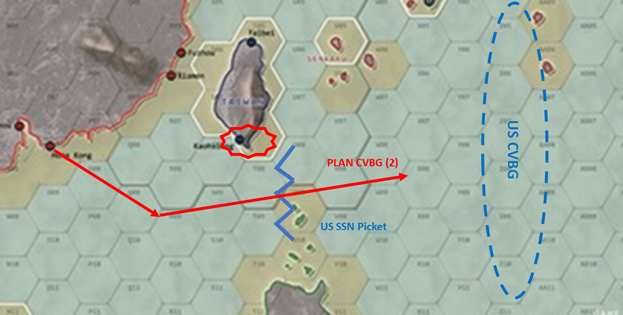
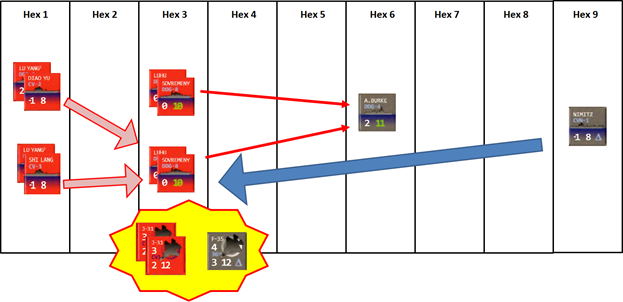
Unfortunately, the PLA(N) was able to dislodge the US CVBG from its safe area.  The PLA(N) had detailed two of its three CVBGs to force the Luzon strait in order to bring the Chinese carriers within reconnaissance range of the US carrier.  Unfortunately for the FICC, the PLA(N) superiority in surface forces (Sovremenny DDGs outnumbering and outranging the US Burke DDGs) won the battle for the Luzon strait for the PLA(N).  As a result, the US CVBG had to retreat to the east, leaving the PRC in complete control of Taiwan airspace.
With Air Superiority over Taiwan secured and most of the Taiwanese navy either sunk or huddling out of the way under the cover of the remaining SAMs, the PRC then had their amphibious convoy set sail for Taiwan attended by a sizable ASW presence.  The only remaining US remaining to bear were the US SSNs waiting in ambush in the Taiwan Strait.  While the US Boats managed to sink a few transports, enough were able to get through to the island and establish a beachhead that the ROC Army could not dislodge.

     Attrit PRC Ground Forces

With ROC Air Force and US air driven from Taiwan airspace, the only FICC force which could carry out the PRC ground force attrition function was the Taiwanese army.  Unfortunately, the Taiwanese army was significantly degraded by this point due to unremitting PRC SRBM strikes and precision air-to-ground strikes by an unfettered PLA Air Force.  The model of SRBM strikes I used may have been too generous to the PRC, but I think it is a fair assessment that hundreds of SRBMs loaded with cluster munitions would have a significant impact on defending troops.

     Degrade PRC Air Capacity

With a significant PRC amphibious presence on the island, the FICC needed to degrade PRC air capacity over the island in order to keep the balance from tipping too steeply against the ROC Army in the land battle.  Due to the processes described above, the FICC was not able to mount significant Combat Air Patrols (CAPs) by the Taiwanese Air Force or Air Superiority Sweeps by the US air units.  To degrade PRC air over Taiwan, the FICC needed to depend on cruise missiles to attack key PRC airfields hosting the PLAAF units pounding Taiwan.  While some degradation was achieved by the US LACM strikes (launched from in-theatre US DDGs, SSNs), the effects were not enough to significantly degrade the ability of the PLAAF to launch sorties against the island.  B-2 strikes were attempted, with few results (not enough B-2s available to make much of a dent).

How could the FICC have Done Better?

I had not expected the FICC effort to crumble so soon, but looking at the designer notes, he had mentioned that players could expect Taiwan to fall quickly if the PRC player chose to make conquering that island their focus.  Given that Taiwan has maintained its independence this long, I suspect that a successful, quick cross-strait invasion is not that forgone a conclusion.  I plan on playing an even more detailed game that focuses on the battle in and over Taiwan (Next War: Taiwan) to explore this further.  Breaking the Chains was a good start for a theatre-level military-political simulation which will provide context for the more focused simulation offered by Next War: Taiwan.

So, before I give my “make better” assessments, a few more caveats.  I acknowledge “garbage in, garbage out”; that my assesments can only as good as my inputs (see the references list below).  All sources are unclassified.  The game I used is primarily designed for playability by civilians.  And finally, I am sure there are perfectly valid military/political/economic considerations that I am not fully aware of that help to explain why the FICC forces are structured as they are.  My assessments should in no way be considered “advice”, but it will be interesting to see where folks in responsible positions make changes congruent with what I put here (imagine me with a “Bingo Card” marking where measures I suggest were taken).

All that being said, my fixes come in 2 categories; (relatively) Easy Fixes and Hard Fixes.  The “make betters” I put forward are limited to enhance the FICC functions of Reduce PRC Amphibious Capacity, Attrit PRC Ground Forces and Degrade PRC Air Capacity

(Relatively) Easy Fixes

      Additional US Carrier on Station at Start of Hostilities

The PLA(N) achieved a “mission kill” of the US carrier by forcing the Luzon Strait and compelling the CVBG to withdraw further to the east in order to avoid detection by the Chinese carriers and possible ensuing destruction by ASBMs.  The PLA(N) succeeded in this primarily due to having 2 CVBGs vs the one of the US.  Despite US qualitative air superiority, the US could not succeed against the combined PLA(N) naval aviation.  The superior PLA(N) surface forces pushed the US Burke DDG pickets back on the CVBG, compelling the US Force to withdraw.  Two US Carriers on station at the onset of hostilities would have made all the difference, winning the battle of the Luzon strait and keeping US air in the fight over Taiwan.  The possibility of US air available for anti-shipping operations over the Taiwan strait could have been enough to keep the PRC amphibious convoy from sailing for the island.

Fortunately, the US is beginning to up patrols of carriers in the Indo-Pacific recently with three in the pacific for the first time in years.  Such a move should positively impact stability and reassure regional allies of US resolve.

             Hold PRC Airbases at Risk

The US operational plan required a substantial degradation in PRC ability to put sorties over Taiwan.  If the PRC gained air superiority, they would be able to clear the Taiwan strait of the ROC navy, finish the ROC air force grounded by SRBM strikes and to drive the ROC Army away from the planned beachheads.  Even with the US and ROC regional land-based air grounded, degraded PRC airfields would have slowed these processes and possibly bought enough time for US reinforcements to stabilize the situation.  Since FICC air was unable to do this for the reasons already given, US LACMs launched from DDGs and SSNs in the area had to take up the slack.  Unfortunately, there were not enough of these to have much effect.  An encouraging development is the refitting of 4 Ohio-Class SSBNs to Tomahawk LACMs.  Each of these would be able to launch salvoes of up to 144 cruise missiles from their vertical launch tubes.  With these on station, the US could have trickled out enough cruise missiles to hit the most important PRC airfields and relieve pressure on the Taiwanese defenders until more substantial aid could arrive.

The B-2s I added to the game were welcome, but there were too few of them to make a difference.  B-2s would be employed most sparingly to hit the highest value targets.

Hard Fixes

               Restructuring ROC Air and Naval Forces

In my opinion, judging from the order of battle of the ROC forces in the game and literature – Taiwan may have the wrong force makeup to resist a cross-strait invasion.  First, the PRC has SRBMs… lots of them… hundreds verging on thousands pointing at the island.  While accuracy may vary, you do not need to be very accurate to punch holes in runways and scatter cluster munitions.  SRBMs will shut down the ROC airbases, and then the Taiwanese Air Force will be grounded.  Grounded, they are out of the fight and will be destroyed while the PLAAF has free run of the skies.  Contesting for air superiority may be beyond the ROC Air Force due to the numerical imbalance, but the good news is that you do not need air superiority to strike critical blows – you just need to be able to fly.  This is especially true in Taiwan’s case, as the Chinese Center-of-Gravity in the early phase of this scenario is slow, vulnerable amphibious transports.  To fly and do what matters, I suggest the ROC employ air forces employ aircraft using Vertical Take Off and Landing (VTOL) from dispersed, impromptu sites around the island.  Much like the original CONOPS of the AV-8 Harrier for operating in the Central European theatre against the Warsaw Pact, ROC VTOL aircraft (such as the VTOL variant of the F-35) would be able to carry out missions in support of ground forces and remain available for the all-important interdiction strikes against the PRC amphibious convoy.  While VTOL mean much lighter loads in weapons and fuel (hence shorter range), you don’t have to have too much lift capacity to carry a couple of Air-to-Surface missiles and a couple of Air-to-Air missiles for self-defense.  As for range, the aircraft would not need much as they would be operating in hit-and-run attacks over the island and the adjacent strait.

The ROC navy seems like it is structured to be a sea-control force on the cheap.  Unfortunately, given the assumption of PRC air superiority given the reasons above, the too few destroyers and frigates of the ROC navy just offer a set of targets for the PLAAF.  In my game, the ROC navy barely got into action.  Sea control, even locally, may be beyond Taiwan vis-à-vis China.  What Taiwan may consider is an enhanced sea-denial navy; denying China a means to cross the strait long enough for help to arrive.  Scrap the Destroyers and Frigates in favor of networked swarms of small, Fast stealthy surface forces equipped with anti-ship missiles and diesel submarines.  Sure this navy will not help Taiwan maintain their claims on rocks in the South China Sea, but the idea that Taiwan would risk providing the PRC with a cause to use force over such claims in far-fetched.

Lastly, the ROC army should be ready to use maximum mobility as a means to avoid being targeted and hit by PRC SRBMs.  The best way to beat a missile is to not be where it is going, and by staying on the move (employing roads off the beaten path and making an additional network of dirt roads), eschewing permanent fixed fighting positions in favor of impromptu fighting positions, and employing tactics emphasizing hit-and-run and ambush attacks the ROC could mitigate the missile threat and remain viable long enough for the tide to turn in the air when US follow-on forces arrive in theatre.

References:

Eric Heginbotham “The U.S.-China Military Scorecard”, Rand Corporation 2015.

IISS “The Military Balance – the Annual Assessment of Global Military Capabilities and Defense Economics 2020”, Routledge 2020.

Alfred Price “Air Battle Central Europe”, Free Press 1986.
Thinking about a Taiwan Contingency via Breaking the Chains

While wargames are commonly used as a vehicles for “participatory history” in examining battles of the past, Wargames are an unparalleled aid for studying current and future national security issues.  Armed with John Gorkowski’s excellent game Breaking the Chains    and selected books, I learned a fair amount about  how a Taiwan contingency might play out, and what aspects of the respective coalitions would help and harm their causes.

A military campaign against China is one of the more likely and consequential contingencies our defense establishment faces.  Much as the US Navy and Marine Corps determined requirements and refined their methods against a hypothetical Japanese threat prior to WWII, the US Defense Establishment will use such a contingency as a focus for determining resources and capabilities and necessary for to deter, and if necessary prevail in such a conflict.

As part of this exercise,  I wrote an abbreviated campaign appreciation from the point of view of the U.S. and her likely regional allies.  I also made some house rule changes to add important aspects (e.g. PRC Ballistic Missiles) that the game did not include.  I’ll do a follow on post-game post to talk about how the game went and some lessons learned.

General Rule Modifications (rule modified):

Diesel Submarine Mobility (14.2) – Diesel subs in illumination range of enemy units must roll 1D10 in see if they can move.  On a 6 or greater, they may move or place/remove the Out of Element (OoE) marker as applicable that General Quarters (GQ) phase.

Single Player Modifications:  Player rolls 1D10 each Movement or Engagement opportunity; on an even roll the First Island Chain Coalition (FICC: Taiwan the U.S. and its allies who join) gets to move/engage and on odd rolls the CC does.  Each movement is done by a single stack per move.  Engagements are declared for one hex per roll.

Airfield Degradation: In addition to attacking air units on airfields, Air and Missile strikes may attack the airfield itself.  Hit results against the airfield result in Damage levels 1, 2 or Out-of-Action (OoA).  Air units operating from Air Fields (either Strike or CAP) suffer an adverse Circumstantial Modifier corresponding to the level of damage of the field.  Units may not Strike or CAP out of an Airfield suffering an OoA result, and units operating out of an OaA airfield do not project an illumination radius. Airfield damage is repaired one level each recovery phase.

Ground Unit Losses (15.2): Shock results from strikes and ground combat are applied in order of size from the smallest unit in a stack to the largest unit.  Units may not get a second shock result until every other unit in the stack has a shock result.

1.0   Establishment of the Basis for Solution of the Problem

1.1 Appropriate Effect Desired

The US-Lead First Island Chain Coalition (FICC) will preserve the independence of the Republic of China (ROC) against PRC aggression by eliminating PRC ability to transport troops to the island of Taiwan and degrading whatever PRC ground forces that do deploy to impotence vis-a-vis ROC forces.  The FICC will also mobilize regional powers against PRC aggression by upholding their rights in contested areas.

 1.1.1 Fundamental Objectives Hierarchy

The Effect Desired is realized by the objective Defeat PRC Effort to Forcibly Annex Taiwan.  That objective is further decomposed into a primarily military (Minimize PRC Military Gains) and political (Minimize Political Legitimacy of PRC Campaign) components.

1.2 Relative Fighting Strength


1.2.1 General Factors


1.2.1.1 Political Factors


Rules Modifications to Victory Conditions (17.3) and Politics Model 12.0

Either the PRC or FICC may win by a political settlement (Political victory) during the Politics segment of each turn.  Both the PRC and FICC start with 0 Political points.  Political points may be acquired by capturing selected hexes.  The PRC gains 2 political points each of the 6 hexes of Taiwan.  The PRC may also get a single point for Okinawa or Guam.  The PRC may also capture the Hanoi, the Senkaku hex, or Spratley hex Q16 for a single point each, but in doing so they bring the hex owner into the FICC immediately.

The FICC may gain political points by capturing China mainland hexes Zhan Jian or Ding Hai, or Paracel island hex N11 for a single Political Point each.

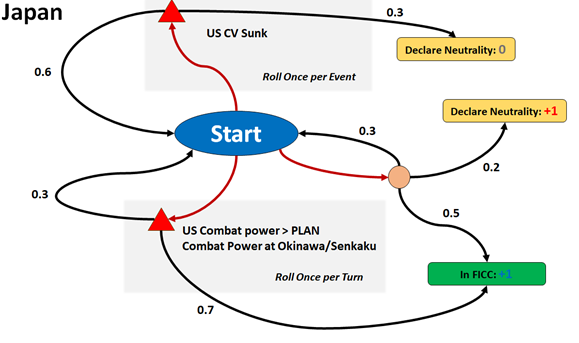
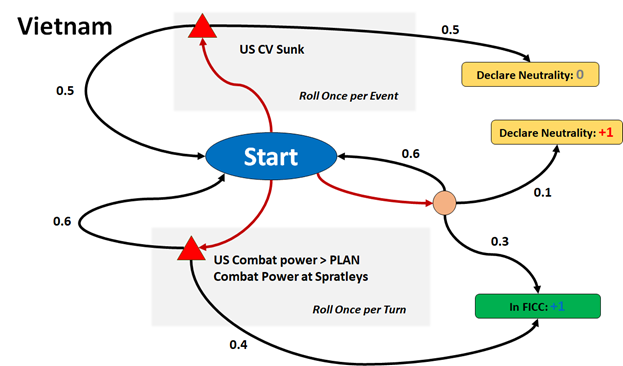
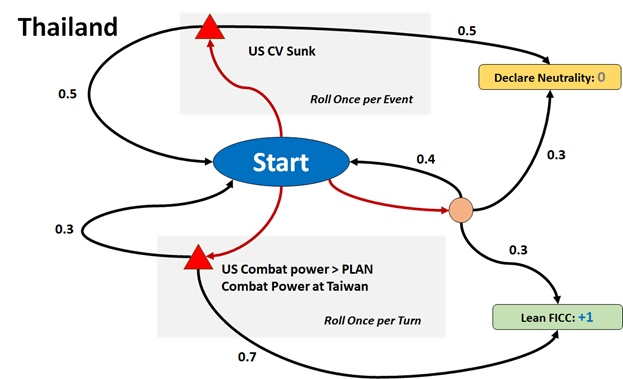
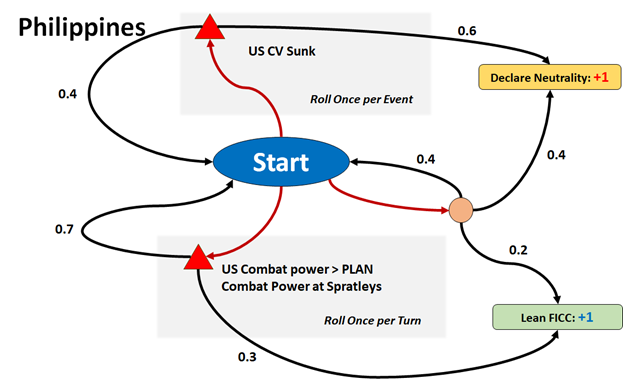
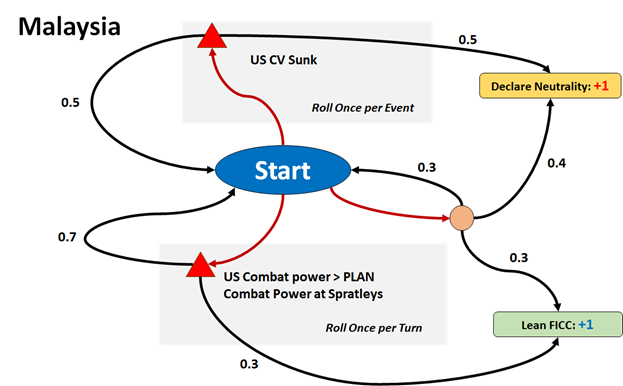
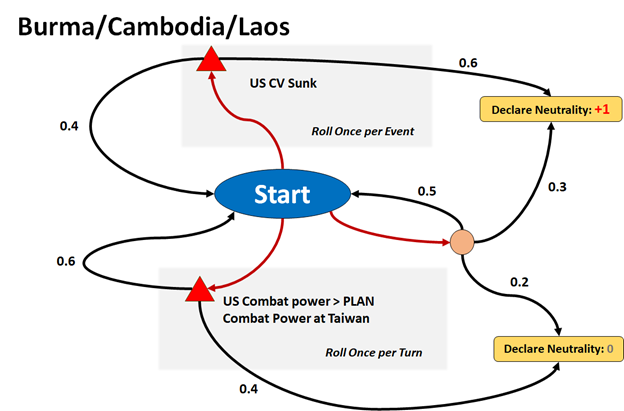
Both Sides may also gain political points by Countries declaring membership in a coalition or neutrality per that nation’s political event rolls (described below).

During the Politics Phase, both the PRC and FICC sum up their political points.  The side with the most points then subtracts the political points of the other side and rolls 1D10.  If the die roll is less than or equal to the difference, then the rolling player wins a minor victory via political settlement.

The PRC wins a Decisive victory as soon as they control all hexes of Taiwan, or upon successful roll for the China Oscar Event.

The China Oscar event is modified so that when the PRC plays this chit, the PRC rolls 1D6 – if the roll is less or equal to the number of Taiwan hexes controlled by the PRC then Taiwan surrenders and the PRC wins decisively.  This event may only be played once.

If neither side achieves a Political victory, or China does not achieve a Decisive victory by overrunning Taiwan, then the winner is determined by victory points at the end of 30 turns (1 month).  The FICC  wins if there is a tie.

The region is home to a number of Countries which may help or hinder the FICC depending on events as the situation unfolds.  These countries may participate by contributing military forces to a coalition, or more passively by backing peace efforts of one or the other coalition of active antagonists.

 FICC and FICC-Leaning Countries

The U.S. and ROC are the core members of the FICC as they are automatically in the FICC at initiation of hostilities.  Japan, Australia and Vietnam may become active participants in the FICC if certain conditions are met.

Japan

While Japan has a mutual defense treaty with the U.S., it is unlikely that Japan will interpret a Taiwan-invasion contingency (even if there are PRC strikes on American bases in Okinawa or elsewhere) as obligating them to commit their own forces.  It is likely that a direct PRC attack on Japanese forces, Installations (Kagoshima), or a move to occupy the Senkakus by the PRC would bring Japan into the FICC.

Japan has a small, but well-equipped Self-Defense Force (SDF) which would act to deny the Senkakus to the PRC and help secure Okinawa.  For political reasons, they would not be allowed to engage in Amphibious operations against mainland China.

To increase the odds of Japan entering the FICC, the U.S. needs to reassure Japan by staging combat power in the waters around Okinawa/Senkakus.

The sinking of a US Aircraft carrier shows up in the political calculations of each country having the make the decision of how or if to become involved.  While the loss of a single aircraft carrier would not decisively degrade U.S. combat power, US carriers have an almost talismanic import to national decisionmakers – and a loss a carrier would certainly trigger a re-evaluation of the FICC chances for prevailing in the conflict.         


                Australia

Australia can be expected to follow its treaty commitment with the U.S. in a Taiwan contingency and contribute forces.  While small, the Australian contingent would include an infantry regiment which could be used to support Vietnamese claims to the Spratleys.

Vietnam

Vietnam’s chief aim will be to uphold its Spratley claims without unduly antagonizing the PRC; especially if China seems to be getting the better of the FICC in the conflict.  A show of force by the FICC to uphold Vietnamese claims in the Spratleys may be enough to induce Vietnam to join the FICC.  Vietnam could contribute forces (which would secure the Spratleys) and provide a vote for a FICC-favorable settlement.


                     Thailand

While Thailand is not likely to offer military assistance, they do carry weight in regional affairs and can lodge a vote for either the FICC or PRC depending on circumstances.

PRC Leaning Countries

Countries leaning towards the PRC are unlikely to contribute their (mostly negligible) military forces to the PRC, but are likely to lend their voices towards a PRC-favorable settlement.  The PRC would be unlikely to antagonize them by occupying disputed territory since prevailing in the conflict would allow the PRC to deal with the rival SCC claimants in the future at leisure without U.S. interference.

                           Philippines

The Philippines leans PRC, but predominant U.S. combat power in the Spratleys may convince Manila to back an FICC settlement.

Malaysia, Burma, Cambodia, Laos

These countries are likely to back a PRC-lead peace initiative.  In the case of Malaysia, an FICC demonstration in the Spratleys may induce Kuala Lumpur to back a FICC-lead peace initiative.

Burma, Cambodia and Laos would likely look to which power looked to be prevailing in Taiwan.  While leaning towards the PRC, these countries value peace and stability and if the FICC seemed to be prevailing, they may back the FICC politically as a vote for the status quo pro ante.

1.2.2 Survey of the Characteristics of the Theatre of Operations

1.2.2.1 Hydrography, Geography, relative Locations and Distances

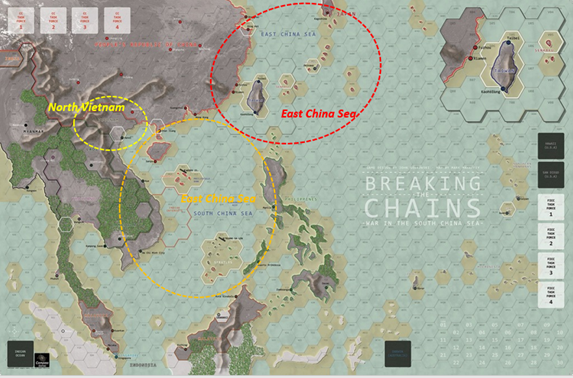
The mapping of Objectives, geographical features and distribution of key installations breaks the theatre into three key regions; East and South China Seas and North Vietnam.

The Key Objectives of preserving the independence of the ROC will be achieved in the East China Sea region.  FICC Air forces operating from Okinawa, Taiwan and a US CVBG will first minimize PRCC combat power on the island of Taiwan by attacking PRCC amphibious assault vessels.  Subsequently FICC Air and Sea Forces will gradually gain control of the Air and Sea over and around the island in preparation for degrading PRCC forces from the island.

The US will also achieve the supporting objective of securing Japanese active participation in the FICC by a show of force in the waters around the Senkaku Islands.

The FICC will achieve the supporting objective of getting Vietnamese participation in the FICC, as well as the political backing of the Philippines by a show of force in the Spratleys.  The FICC will also achieve the supporting objective of drawing PRCC forces from the decisive region with assaults to seize Chinese-held islands in the Paracels.

The US is not expected to directly commit forces to Northern Vietnam, but will support with missiles and/or air strikes in order to support Vietnamese forces as they tie up PRCC forces.

The bulk of US Air and Sea forces are available in theatre at the start, with follow-on forces surging into the area as described below.

1.2.2.2 Key Installations

PRCC

Taiwan Strait

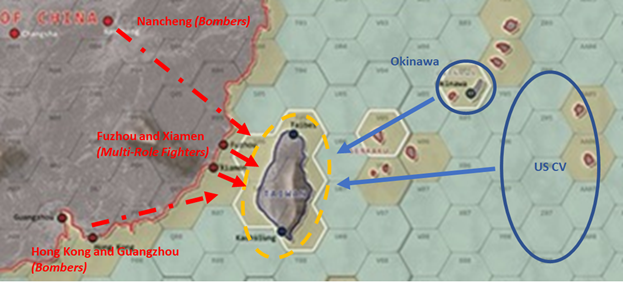
The PRCC will rely on Fuzhou and Xiamen as Airfields to secure air superiority over Taiwan and to project Airpower against ROC ground forces.  These sites will also be the staging area for troops embarking for the invasion of Taiwan.

Reconnaissance from Fuzhou and Xiamen airfields will also keep US CVBGs from approaching Taiwan and prevent US amphibious forces from landing on Taiwan.

South China Sea

Woody Island airfield will serve as a tripwire preventing US CVBGs or troops from operating in the Northern Part of the South China sea by acting as the scout for PRCC ASBM forces.  Sanya on Hainan island will be vital to defend Woody Island from air strikes or amphibious/airborne assault.

FICC

Taiwan and East China Sea

ROC airfields are vital to attriting PRCC amphibious landings and contesting air superiority over Taiwan.  The ROC Airfield of Kaohsiung will be especially important, as it would serve as a scout for the FICC screen of the Luzon Strait.

The US will primarily project Airpower over Taiwan from Okinawa.  It is expected that air operations from Okinawa will be significantly impacted by PRCC MRBMs.  Okinawa together with Kagoshima will provide scouting and force projection necessary to prevent PRCC forces from heading east out of the East China Sea.

South China Sea

Ho Chi Minh City is the only safe locale that could serve as the origin site for a US Airborne assault on Woody Island in the Paracels.

1.2.3 Factors More Directly Applicable to the Armed Forces

1.2.3.1 Regional Geography

The Island of Taiwan is separated from the mainland by the Taiwan strait.  PRC is expected to make an early and vigorous effort to hold and maintain sea control of this Strait, as this is where they would have to cross to make amphibious landings on the easily secured western coast of the island.  The east coast of the island also offers the least challenging terrain.

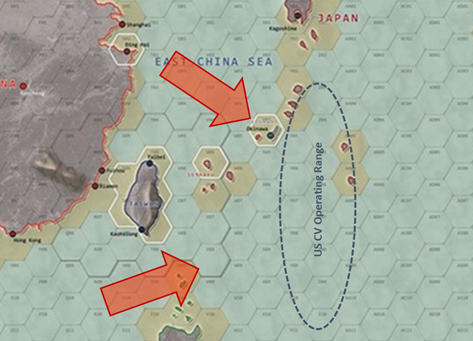
Given the threat of the DF-21D ASBM, US Carriers providing direct support to forces on the island of Taiwan will need to operate in waters to the east of the Island.  US Forces must ensure the region remains clear of PRC forces which could scout for the missile forces.

The PRC is able to locally contest sea control in the East China sea enough to enable an amphibious campaign to subdue Taiwan.  The PRC can project land-based air, Ballistic and Cruise missile strength in the East China sea enough to suppress ROC defenses and hold CVBGs operating off Taiwan or in the South China sea at risk.

The PRC has limited ability to project power past the first island chain, but by using their carrier battle groups in as scouts for the PRC 2nd Artillery ASBMs, they can achieve a mission kill of US carriers by denying them a safe operating area to the east of Taiwan.  To maintain this safe area, the US will need to deny the PRC safe transit of two key waterways.

While the East China Sea provides the most direct path to the US CV Operating area, it is barred by the US Base at Okinawa and abuts the Japanese base of Kagoshima.  PRC forces transiting these waters would be subject to scouting from these bases, and with this scouting US CVs would be able to sorties without reply from PRC CVs.  PRC is not likely to be able to neutralize both of these bases for any significant time, so the risk PRC sorties from the East China sea is considered low.

On the other hand, the Luzon strait between Taiwan and the Philippines (which is expected to remain neutral) provides a path for PRC forces over which they would only need to neutralize one base (Kaohsiung).   Given the imperative for the PRC to dislodge US carriers from the waters near Taiwan, and the relative ease to secure this strait, it is judged a near certainty the PRC will attempt to sortie via this waterway.

1.2.2.1 Vessels, including Aircraft and Missiles

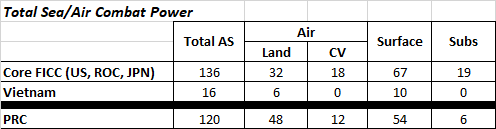
Overall, the FICC (Including U.S., Taiwan, Japan and Vietnam) has more combat power overall in terms of Anti-Shipping firepower in the theatre.  This metric is considered most important in the contest of controlling the Sea and Air around Taiwan which is the main FICC Objective.

PRC Ballistic and Land Attack Cruise Missiles

PRC Ballistic missiles (exemplified by the DF-11 SRBM) provide a substantial threat to forces on Taiwan.  An estimated 800 or so DF-11 stand ready to attack fixed installations such as Airfields and Fortification and can also be expected to be employed against ROC troops.  BTC does not model this, so I used the following model:

RULE ADDITIONS: Chinese Ballistic Missiles

During the GQ phase, the PRC may launch SRBM strikes against either Taiwan or Northern Vietnam (no further south than Hanoi).  The PRC player has 100 SRBM points at the beginning of the game, which they may use.  To use SRBMs, the PRC player denotes the number of points to use against each target hex (max of 6 points per hex) during each GQ Phase.  The number allocated per strike serves as the weapon system score for that strike.  SRBM strikes may only be executed against Divisions, Regiments, MEU or Airfields.  After each strike, the points allocated to the strike are lost.

SRBM launchers are not modeled in the game as they are considered too numerous to effectively target.

The PRC also employs the DF-21D which can also target Aircraft Carriers underway at sea.  The DF-21D has only recently been rated as an Anti-Ship Ballistic Missile (ASBM), so the following rule models the uncertainty of its performance:

RULE MODIFICATION: DF-21D ASBM Performance (16.0)

The Weapons System Score of the DF-21D is modeled as having a 30% Chance at being under-performing (4), 50% Chance of working as predicted (5) and a 20% Chance of being better than predicted (6).  The PRC has up to 15 DF-21D shots which they may make during any General Quarters segment. The PRC may only make one DF-21D shot per general quarters cycle.

The PRC also operates a variant of the DF-21 (C), which can hit bases in the Ryukus (Okinawa) or Kyushu (Kagoshima).  The PRC gets 10 DF-21C shots in the game.  DF-21C shots originate from SSM units.

The Satellite Warfare event reduces all missile strikes Weapon System score by 2 as it does for LACM strikes.

Unlike LACM strikes, ballistic missile strikes may only be launched against Ground Units, Airfields or Ships in Ports – not SAMs.

RULE MODIFICATION: PRC Air Launched LACM

The PRC may make up to 8 LACM strikes using LACMs carried by their H-6 bombers.  These LACMs work like any other PRC LACM.

Ballistic Missiles are key to seizing Taiwan, as they are unstoppable combat power which will attrit ROC ground forces, and degrade air fields before PRC boots even reach the island.  The scenario will start with an overwhelming bombardment of ROC key airfields and troops.  PRC IRBMs can be expected to hit Okinawa at the onset of hostilities as well.

The threat of the PRC DF-21D ASBM constrains operations of US CVBGs in important ways.  Given the DF-21D, and the risks it poses to carriers, carriers must at all times operate in manner that keeps carriers out of illumination by any PRC platform.  LPH-borne Amphibious forces are similarly constrained – as a result, no amphibious assaults in scouting range of PRC assets is allowed.  This makes FICC amphibious assaults on Taiwan, the Paracels or the Chinese mainland impossible.

The PRC is also well-stocked with cruise missiles which can be launched from a number of platforms.  Cruise Missiles will chiefly be employed to degrade air defenses at the onset of the conflict, paving the way for follow-on Ballistic Missile and Air Attacks.

The most critical engagement of the campaign will be the ongoing air battle over the island of Taiwan.  The PRC will need air superiority in order to further attrit ROC Troops and protect their own fragile beachhead.  The FICC will not have the resources to contest for air superiority, but may be able to achieve the FICC objective of degrading PRC ground forces, nonetheless.

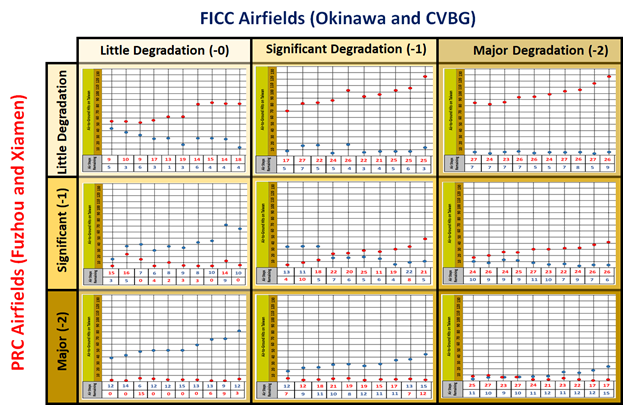
ROC aircraft will be largely out of action due to PRC missile strikes degrading their airfields and subsequent aircraft strikes on grounded aircraft.  The PRC heavily outnumbers available (9 units to 5) FICC aircraft.  In addition to numbers, the primary PRC airfields (Fuzhou and Xiamen) are close enough to the airspace that they do not suffer degradation of combat performance due to range, whereas the FICC flying from Okinawa and a US CV to the east of Taiwan does.  Air superiority is out of the question for the FICC, but if the FICC is able to degrade the primary PRC airbases, they can regain a measure of control over the airspace and most importantly, possibly eliminate PRC ground forces that do manage to get ashore.  A simulation of this air campaign was done, using the assumptions:

  • PRC starts with 9 multi-role units, FICC starts with 5
  • FICC aircraft have air-to-air and air-to-surface performance degraded for long distance
  • FICC aircraft fly air-to-ground missions, while PRC fly a matching number of units for each turn to intercept FICC ground strikes, while the remainder fly their own ground strikes.

The key MOE is the number of ground hits the antagonists can deliver in the course of the campaign.

The simulation was run ten times for each combination of airfield states.  Each simulation was run for 7 turns of 6 General Quarters phases each. The key takeaway is that the FICC must strive to protect Okinawa and a US CV while degrading PRC airfields in order to contest for ROC airspace.

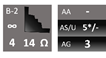
The game omitted explicitly representing US Strategic air, which I think is a mistake.  Penetration of PRC air defenses would be the ideal job for the B-2 stealth bomber, which I added to the game as a single-step unit.

The B-2 is subject to anti-air from Area SAM units as other aircraft, however the SAM needs to get the same number with three dice (versus 2 for other air) in order to hit.  The B-2 has no air-to-air capability.

Also the B-2 may only attach Satellite-Illuminated targets in AS combat (as LACM).  The B-2 is can be employed via the ‘Widowmaker’ special event any number of times per game, as long as they are not used on contiguous turns.  Once eliminated, the B-2s are out of the game.

Unfortunately, being a Strategic Weapons system, B-2 strikes could conceivably be mistaken by the PRC as strikes on PRC Strategic (Nuclear) capacity.  Given the relative imbalance of Strategic forces in favor of the US, the PRC would be understandably anxious as to the safety of their own nuclear deterrent.  To model this, each time the B-2 strikes a target in a non-coastal hex the US player rolls 1D20.  On a ‘20’ the PRC launches a nuclear strike and the US player loses decisively.  While the US would not “lose” a nuclear exchange, and further escalation would likely be contained, the idea that the US loses Anchorage Alaska (PRC weapon launch on Elmendorf AFB) due to a misunderstanding in a conflict where US survival is not at stake would give US Leaders pause in employing the B-2 in this campaign.

The PRC will attempt a mission kill on the US CV directly supporting Taiwan by attempting to close on the CVBG with CVBGs of their own.  The US CVBGs need to keep a distance of more than 6 hexes from the PRC air units, or they become liable to strikes from the DF-21D.  As mentioned previously, this PRC thrust is likely to come via the Luzon strait.

The PLAN will likely send 2 CVBGs, each consisting of a CV, a Lu Yang DDG for area air defense, a Sovremeny and Lu Hu DDG and a Jiang Kai FFG for ASW.  All of this arrayed against a US CVN with a set of Burke DDGs performing all roles.

The US CV has a key advantage in the range of their air wing vis-à-vis the PLAN (4 vs 3).  They seek to illuminate the PLAN CVs at 7 to 8 hexes distant in order to attack and destroy the PLAN CVs.  The first opportunity to do illuminate the PLAN CVs would be from the ROC airbase of Kaohsiung on the south coast of Taiwan.  It is expected that this base would have been put out of action by the PRC prior to attempting this operation.  The other opportunity comes from the Virginia SSN detailed to picket the Luzon strait.  This force has a high likelihood of being able to successfully approach a PLAN CV and enable a US strike.  This is the desired outcome for the FICC.

The PLAN will deploy FFGs to find and destroy the US SSN at earliest opportunity.  If the PLAN succeeds in getting past the US SSN, then they face the scenario below. Each PLAN CVBG can also be expected to deploy a SAG centered on a Sovremeny DDG attempting to get early illumination of the US CVN with their 3 hex illumination range.  This PLAN DDG will operate within range of PLAN air interception for protection.  The US should counter by having their own Burke DDGs on picket duty within the 4 hex intercept range of the US air wing.

The resulting situation has 2 Sovremeny-centered SAG vs the US DDG picket.  The Sovremenys outrange the US DDG and can initiate AS combat without reply from the US DDG.  The US would be able to engage the PLAN SAGs with the US Air Wing, but the Chinese would be able to engage the US air wing via intercept combat, with an advantage both in both numbers and range.  While it is possible for the US to prevail in this situation, success is not likely in this situation, so all efforts must be made to succeed with the SSN picket making contact with the PLAN CVs.

1.2.2.2 Ground Forces

The PRC has 14 units, both Marine and Airborne for invading Taiwan.  It is likely 1 unit of airborne will be retained as a reserve for the SCC.  These forces face a ROC army of 15 units.  The limiting factor for the PRC is that only have the capacity to transport 5 units via amphibious assault, and 1 airborne per GQ phase.  The FICC will have opportunities to destroy these transports both in transit (via submarine in Taiwan strait) and via LACM as they return to port for more troops.  Attrition from these events means that is it unlikely the full  complement of PRC units will be transported to Taiwan.  We estimate no more than 8 units of Marines will land on Taiwan, and 3 airborne units.

The number of PRC steps on Taiwan drives the PRC requirements for control of the air:  they cannot tolerate any scenario that would result in more than 30 ground hits, as this could eliminate PRC forces on the island.

PRC forces will land on the west coast, since the PLAN will likely control the Taiwan strait and the terrain of these hexes make them easier to attack.

Due to the DF-21D ASBM, US may not make amphibious assaults on land within illumination range of PRC air.  This precludes amphibious operations on Taiwan or the Spratleys.  Taiwan airfields would likely be unavailable as destinations for US Airlift due to Chinese missiles.  As a result, US ground operations are probably limited to defense of Okinawa and Guam, and possible offensive airborne operations against Woody island.

2.0   Determination of Suitable, Feasible and Acceptable Course of Action

2.1 From Fundamental Objectives to Means Objectives

Means objectives were devised to respond to the Fundamental Objectives Minimize PRC Military Gains and Maximize pro-FICC Declarations.  While a fundamental objective, there were no suitable means objectives to address Minimize pro-PRC Declarations.  This objective is addressed mostly via the operational constraints on US CV actions to keep them safe.

2.2 Analysis of the Assigned Objectives and Phasing

The Center of Gravity (COG) for the PRC begins as the irreplaceable Amphibious Transports required to bring the bulk of PRC ground forces to Taiwan.  Once these transports are destroyed, the PRC COG shifts to the PRC Marine and Airborne troops on the Island of Taiwan.  This shift in PRC COG delineates the two primary phases of the FICC campaign.

FICC (mostly US) air power directly in contact with Taiwan is the FICC COG.  US Land-based and carrier-based air will be the primary method for attriting PRC ground on the island of Taiwan.

The FICC campaign consists primarily of 6 operations:

Reduce PRC Amphibious Capacity:  Direct operations against Amphibious transports, in transit and in port.  Success in the operation reduces PRC forces conveyed, and prevents subsequent augmentation of these forces.

Attrit PRC Ground Forces:  Direct operations against PRC Ground Forces, primarily on the Island of Taiwan.  This is also achieved indirectly through destruction of Troop-laden Amphibious transports en route to Taiwan.

Degrade PRC Air Capacity: Operations to degrade PRC capability for projecting power against Taiwan via air.  This is done primarily through degrading Fuzhou, Xiamen and other airfields directly supporting the invasion.

Show of Force – Senkaku: Operate US CVs in Senkaku area as soon as possible so that Japan is likely to join the FICC in active operations.

Show of Force – Spratleys: Operate US CVs in Spratley Islands area as soon as possible so that Vietnam aligns with FICC in the interest of upholding its Spratley claims.  Similarly, induce Philippines to side with FICC to uphold their claim.  Secure Vietnamese and Philippine claims against subsequent PRC aggression.

Seize Woody Island: Get PRC to commit forces to protecting Woody Island from possible FICC airborne assault.  This operation succeeds to the degree it keeps PRC forces away from the main action in Taiwan.  Seize Woody Island if opportunity arises.

3.0 Courses of Action

3.1 Likely Enemy Course of Action

PRC will be on the Strategic offensive in invading Taiwan, but Strategic Defensive in SCC.  The PRC will open their campaign with a massive bombardment of SRBMs and LACMs on Airfields and SAMs on Taiwan and IRBMs and LACMs on Okinawa.  The Air campaign against Taiwan will proceed in three steps:

  1. ) Eliminate SAMs via LACM
  2. ) Degrade Airfields via SRBMs
  3. ) Eliminate grounded Aircraft via Air-to-Ground Strikes

Simultaneously, the PRC will follow reduce Okinawa through LACM/IRBM attacks.  Once sufficiently degraded, PRC Bombers will conduct Air-to-Air strikes to eliminate the grounded Aircraft.

The PRC will remove the US CVBG from it op area through direct attack via an SSN patrol which will attempt to make contact in order to enable a DF-21D ASBM strike on the CV.  The PRC will also transit the Luzon strait with 2 CVBGs to confront and drive off the US CV with the threat of illumination and subsequent DF-21D ASBM strikes.

The PLAN littoral units will clear the Taiwan strait of ROC navy units and provide security against US SSNs.  Control of the Taiwan strait will be retained, enabling the transfer of PRC units between the East and South China sea along interior lines.

Once the PRC cleared the Taiwan strait and has ensured security from air attack on the Taiwan strait, the PRC will commence with an amphibious assault on a Western coastal hex of Taiwan.  PRC Airborne forces will directly augment this assault as available.

PRC amphibious transports will make as many repeat trips to Taiwan as possible.  The PLAAF an PLAN air units will then focus on protecting PLAN ground forces on the island of Taiwan through defensive air ops and continuing attacks on Okinawa.  It is expected that the US will regain sea control off eastern Taiwan upon the arrival of reinforcements.  The PLAN CVs will then operate under security of PRC land-based air, and use their air in defensive operations to protect CV ground.

3.2 FICC Course of Action

The FICC will operate in two main Areas of Operations: East and South China AOs.  Operations in both AOs proceed in two phases.

East China AO Phase 1: Attrit Amphibious Capability

Initial FICC strikes will focus on eliminating SAMs at Fuzhou and Xiamen, with secondary strikes on SAMs protecting bomber bases.

US SSN patrol the Taiwan strait to eliminate as many PRC amphibious transports as possible.

US CVBG will provide a show of force off the Senkakus, paving the way for active participation by Japan in the FICC.

US Land (Okinawa) and CV Air Units will conduct air-to-ground strikes on PRC Amphibious Transports (first priority) and PRC troops on the Island of Taiwan.  The US CVNs off Taiwan will operate at a distance from PRC air units to prevent their illumination (6 hexes) and consequent destruction by ASBMs.  This CV AO will protected by security measures on the Luzon strait and East China sea, preventing PRC forces from sortieing against the CV AO from either of those areas.

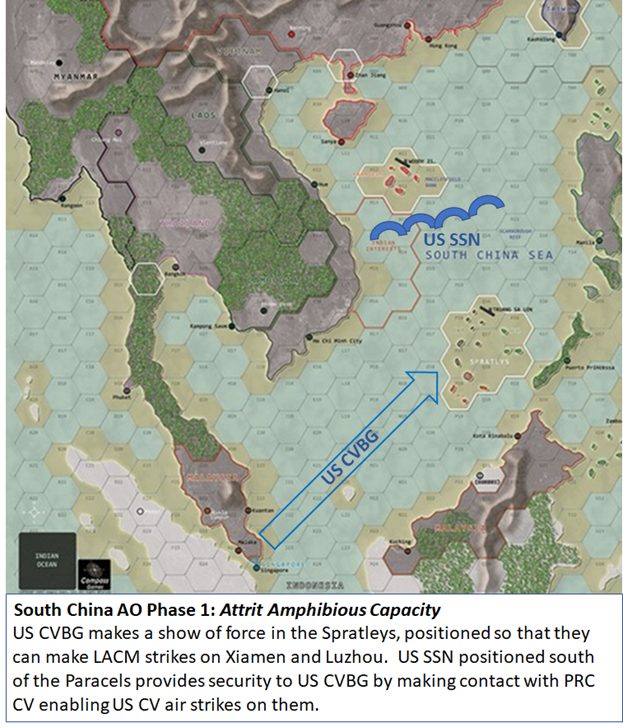
South China AO Phase 1: Attrit Amphibious Capability

The US CVBG will make a show off force off the Spratleys, and position itself to enable LACM strikes on PRC airbases at Xiamen and Luzhou.  Security for this force will be provided by US SSN positioned south of the Paracels.

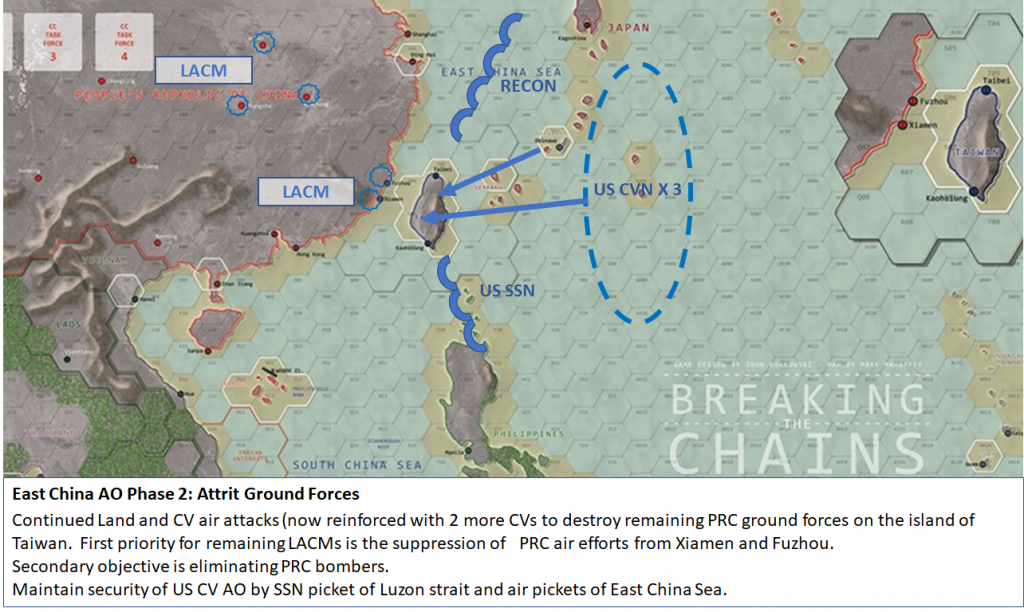
East China AO Phase 2: Attrit Ground Forces

FICC Air strikes (now augmented up to 3 CVBGs) focus on eliminating PRC ground forces on the Island of Taiwan.  LACM and B-2 strikes on Xiamen and Fuzhou suppress PRC air over Taiwan.  Security measures on the East China Sea and Luzon strait protect the US Carriers in their AO.


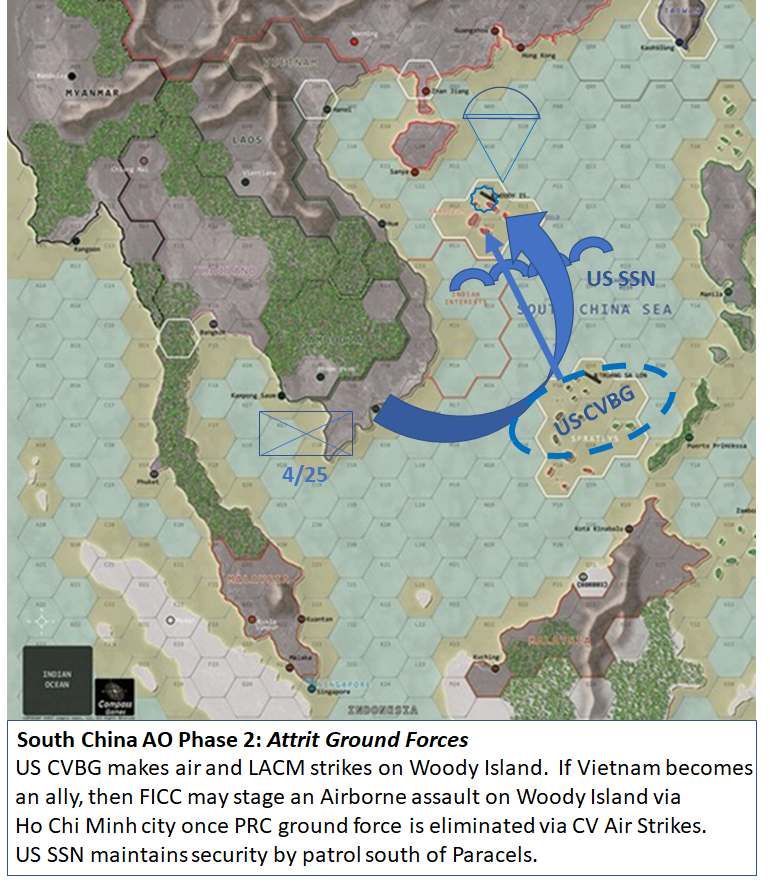
South China AO Phase 2: Attrit Ground Forces

FICC threatens Woody island and ties up PRC ground, sea and air forces in its defense keeping them from defending against the main FICC effort in Taiwan.  LACM strikes on Woody Island to eliminate SAM followed up by CV Air Strikes on ground forces open the island up to Airborne Assault.  US CVBG continues to perform LACM strikes on main PRC airbases of Xiamen and Luzhou.

Bibliography:

Toshi Yoshihara and James R. Holmes “Red Star Over the Pacific (2nd Edition)”   Naval Institute Press 2018.

Eric Heginbotham “The U.S.-China Military Scorecard”  Rand Corporation 2015.