
I am going to go out on a limb and say that just about every wargamer who has been playing games for decades has had an idea for a game of their own that they have at least semi-seriously tried to implement and have published. In my experience, I can think of at least 3 easy ways for a Player to suddenly find themself becoming a Designer:
- Those “house rules” to a loved game that metastasized into a game in its own right
- Tweaking a previous game to cover another subject or scenario
- Coming up with Campaign Rules for an erstwhile battle game (how my game got started)
This being said, if you have the time and intense, almost proselytizing interest in a gaming topic..
You should design a wargame
Really why not… so far nothing too mystical about it, and there are a bunch of upsides to going through the process.
Wargame Design has been a great way of learning/experiencing a topic of interest. Wargame design gives one the opportunity to “live” in the period of the topic and delve into not just the record of what happened, but to understand what could have happened and why. Selecting a topic, posing a set of questions, and scoping enough of the subject to make a worthwhile game requires one to conceive and represent a piece of history as a dynamic system.
If you are looking for a true left-right brain activity, you could hardly do better than Wargame Design. You get to take a historical topic, do a bunch of qualitative and quantitative analyses, and try to represent it in a closed form that fits in a box and can produce credible outcomes in a playable amount of time. Making it work requires probability and statistics, graphic design, historical analyses, storytelling and lots of clear writing.
I have not done a survey, but I suspect that part of the renaissance of wargaming we’ve been experiencing has been the influx of a new generation of game designers that have taken notes on playability and accessibility from the wider world of Euro-games. When I started gaming back in ye olden days (the 80s, when lovable dinosaurs such as Avalon Hill, SPI and Victory Games walked the Earth), counters stalking hex-demarcated maps ways pretty much most of what you would see. It took a critical mass of new design talent to introduce new mechanisms (e.g. cards-driven games, etc.) allowing wargames to more fully tackle aspects of conflict such as politics and economics. Today’s more varied, subtle and powerful wargaming treatments are reaching a wider audience, resulting in a virtuous cycle of more and better games in my opinion.
My “Accidental” Wargame: A Distant Thunder
So back to my happy accidental wargame in progress, A Distant Thunder in development to be published by Heritage games. This post serves as something of an introduction to the game, and the beginning of a series of Designer’s Notes.
A Distant Thunder (hereafter referred to as ADT), got its start as campaign rules to a miniatures-based tactical game called General-at-Sea designed by Iain Stanford and published by the Pike and Shot Society in the U.K.
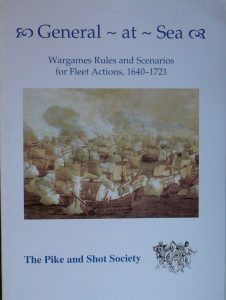
I had never fancied myself a miniatures gamer (who wants to paint? I want to game!), but the system and, above all the subject called to me. So after futzing around with play-aids, and bolting on campaign rules, I started to see that this game could fill a BIG gap in naval wargames…
The Anglo-Dutch Wars, the Beginning of the Age of Fighting Sail
A goldmine for wargame design is to find an important subject/campaign/battle that has not been done to death and provide an original, compelling treatment of it. The Anglo Dutch Wars of the mid seventeenth century, in my estimation, has been sorely overlooked in games (and by armchair historians of the Age of Fighting Sail) in favor of the Napoleonic era. While just about anybody with a nodding cognizance of naval history can pick Nelson out of a lineup, it takes a saltier salt to pick out a DeRuyter or a Blake… even though these men were arguably even more important to the overall story of how wars would be fought and won at sea for the entire age of sail.
While war at sea has been part of the human experience ever since men have plied the oceans for fun and profit, what we would come to call Naval warfare had its true beginning in the mid 1600s.
Up to this point, major sea fights had been either directly ancillary to a battle on land (e.g. Actium) or to contest the movement or ability to move troops over the sea (e.g. Sluys, the Spanish Armada, Leptano). In the first case, a sea battle was not really a separate engagement as much as it was the flanks of the armies extending out to the sea. In the second case, the major object of the campaign could only be secured by moving troops across water, and both sides were equipped to contest the issue.
Battles fought at sea had up to the mid 1600s been traditionally fought in much the same way as land battles. While the inherent challenges of the medium (sea fights are more subject to conditions of wind and tides are a factor) were acknowledged, the concepts for a sea fight were by in large borrowed wholesale from land fights. Tactics were replete with talk about Wings, flanks. The notion of a “Squadron” as an organizational unit was borrowed from cavalry.
And not only did fleets fight much like armies (and fleets were commanded by men who styled themselves as “Generals”… “Admirals” had not been invented yet.), but ship-to-ship actions were about putting your ship in an advantageous position to board the enemy and fight with the tools of soldiers. Ships were structured like castles at sea (e.g. the forecastle).
By the time of the 17th century, the dominant naval powers were now in northern Europe instead of the Mediterranean. As a consequence, the naval state-of-the-art began to reflect the realities of northern European waters and the needs of the navies operating in those seas. Galleys, previously dominant in the waters of the Mediterranean made little sense in the north Atlantic (as Spanish forays against the Dutch Republic would demonstrate). The galley would be eclipsed by the square-rigged man of war, as descended from the Race Galleons that fought with and for the Spanish Armada.
Square rigged vessels, besides being better suited for the naval campaigns of the newly dominant northern European powers, were complicated machines demanding specialized personnel to design, build, operate, maintain and increasingly, to lead in combat. While the hitherto dominant galley-based navies could be largely extemporized when needed, square-rigger navies required true seafaring populations to be effective; populations which the new sea powers were able to provide.
The Anglo-Dutch wars was the culmination of a number of trends which together pointed to a new way of warfare that would hold largely intact until the age of steam and iron around the mid 19th century. The renowned naval strategist Alfred Thayer Mahan began his historical survey of war at sea as part of his masterwork The Influence of Sea Power upon History 1660-1783 with the Anglo-Dutch wars. A major reason was that the Anglo-Dutch conflict was the first (and quintessential) example of what we would call a maritime conflict; a conflict where the antagonists would achieve their primary aims by using means of sea control in order to gain command of the sea. In the Anglo-Dutch wars, the English and the Dutch economies were vitally dependent on overseas trade, and had structured their defense establishments accordingly to service and operate powerful navies to secure their respective access to the oceans.
The state of the art of ships was the square-rigged sailing ship, now fully vested as a broadside delivery platform (as opposed to the galley, with forward-facing ordinance only). By mounting weapons on the broadside, ships could now mount many more cannon, at the price of being constrained to fire mostly perpendicular to the axis of motion. Along with more guns came better guns in the form of molded brass cannon. The new guns were more reliable and could sustain a higher rate of fire. The increasing efficacy of cannon meant that sea fights would be less about soldiers boarding than employing gunnery to batter opponents at a distance. The emerging tactics of the period began to reflect these realities, most notably with the English formalization of the notion of the close-hauled line ahead formation.
The increasing size and complexity of ships meant more weatherly, capable and puissant ships. These ships demanded a class of professionals inured to the sea from an early age to get the most out of them. While leadership afloat was largely bifurcated between those responsible for navigation/seamanship and command, this bifurcation began to blur in more effective commanders as the demands of the new style of war at sea became evident.
So Why an Anglo Dutch War game?
First and foremost, I love the period! The European Baroque period comes with a distinct romance that authors such as J.D. Davies has done much to convey. Naval engagements of these wars were documented in gorgeous paintings (the “combat photography” of their day), and the ships themselves were sumptuous works of art meant to convey the wealth and power of their states.
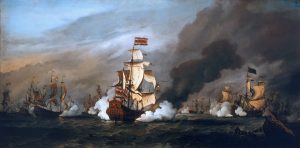
The Anglo Dutch wars were a time of tremendous innovation, fueled by an intense and deadly struggle between the English (both as the Commonwealth and the Restored Monarchy), the Dutch Republic and the emerging French Navy. The pace of action of the naval campaigns would be never again be matched in the age of sail. From May until about November of each of these wars, consequential main fleet engagements would happen approximately every two months. Subsequent wars at sea (such as the Napoleonic Wars) would see fleets engage far less. This prodigious pace spurred innovations which would be tested and refined quickly in the crucible of combat.
Another reason was that I felt that this vital period had been given short-shrift in terms of gaming attention. As I mentioned, I started down this road with General-at-Sea; a miniatures-based tactical only game. Having read Mahan’s book and taking an interest in the period, I had found little to cover it. The only other game I had found on the topic was When Lions Sailed by Joseph Miranda. While this is a fun game, it did not quite ring historically plausible for me (a lot of what you could do in the game, and the global focus seemed more appropriate to a Napoleonic era game – battle fleets of the Anglo Dutch era had very little sea keeping ability and were essentially limited to 2-3 week cruises in home waters due to supply limitations). Here was a grand opportunity to do an operational level (also rare for war at sea games – most focus on battle) Anglo Dutch game!
Enter A Distant Thunder
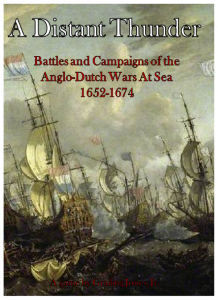
The joy of wargame design for me is to make the games I wish were available, and that is what you’ll see going forward. Beware game design is not my day job, so progress will be slower than I’d like, but tune in here for updates and details.
For Further Reading:
The Anglo-Dutch Naval Wars 1652-1674
by D. R. Hainsworth, Christine Churches, Roger Hainsworth
War at Sea in the Age of Sail (Smithsonian History of Warfare) Paperback August 23, 2005
by Andrew Lambert
Pepy’s Navy: The Ships, Men and Organization, 1649-168
by J. David Davies
The influence of sea power upon history, 1660-1805
by A. T Mahan
The Line of Battle: The Sailing Warship 1650-1840 (Conway’s History of the Ship) by Gardiner, Robert, ed. (1992)
Sea Power: A Naval History
by E.B., and Chester W. Nimitz, edited by Potter