
A big part of what I want to do with this blog is to look at particularly interesting epochs of change in military affairs, particularly in U.S. military affairs with a (critical) eye out for lessons learned. Usually, the historical subject is selected based on which game I want to get on my table lately. In this case, the game was Seapower & the State: A Strategic Study of World War Three at Sea, 1984-1994 by Stephen Newburg published by Simulations Canada in 1982.
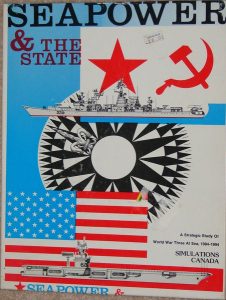
I came across this game when I read The Art of Wargaming by Peter Perla and read his description of how he used this game to introduce analysts to Wargaming as a tool for understanding strategic contexts. Given my soft spot for contemporary, strategic-level simulations (especially WWIII circa 1980), I predictably got onto Boardgamegeek and acquired a copy. When I got it on the table, I was not disappointed in the least. In 12 pages of rules, Stephen Newburg managed to distill many books worth if material on the relative Doctrines and Strategies of the Soviets and NATO/Free World navies of the 1980s. It is a tribute to this game, that it has been a joy thus far just to have the game set up on the table in order to appreciate the overall statement on the subject presented by this game. I decided to use this game as a vehicle to evaluate critiques of the U.S. Maritime Strategy (awkward name… as if there were no other Maritime Strategies…ever!) of the 1980s.
While the study of Strategies is an ongoing theme for this blog, the U.S. naval strategies of 1890-2000s are particularly interesting as they touch on so many of the geopolitical issues of their respective times, reflecting our national aspirations, fears, capabilities and values and expressing them in a form that presidents could advocate, legislatures could fund and servicemembers could fight.
Studying Strategy
Strategy, broadly defined, is the intentional allocation of resources to achieve stated aims. As such, strategies reflect the realities of their times (e.g. threats, goals available means, geo-political context) and can serve as convenient “chapters” for understanding the evolution of a nation’s defense establishment.
Given the scope of naval issues, it seemed to me that naval strategy seemed a good place to start as a vehicle for looking at how the American concept of “hard” (i.e. force and the threat of force) power has evolved over the turbulent 20th century.
Brief Overview of American Naval Strategy 1890-1900
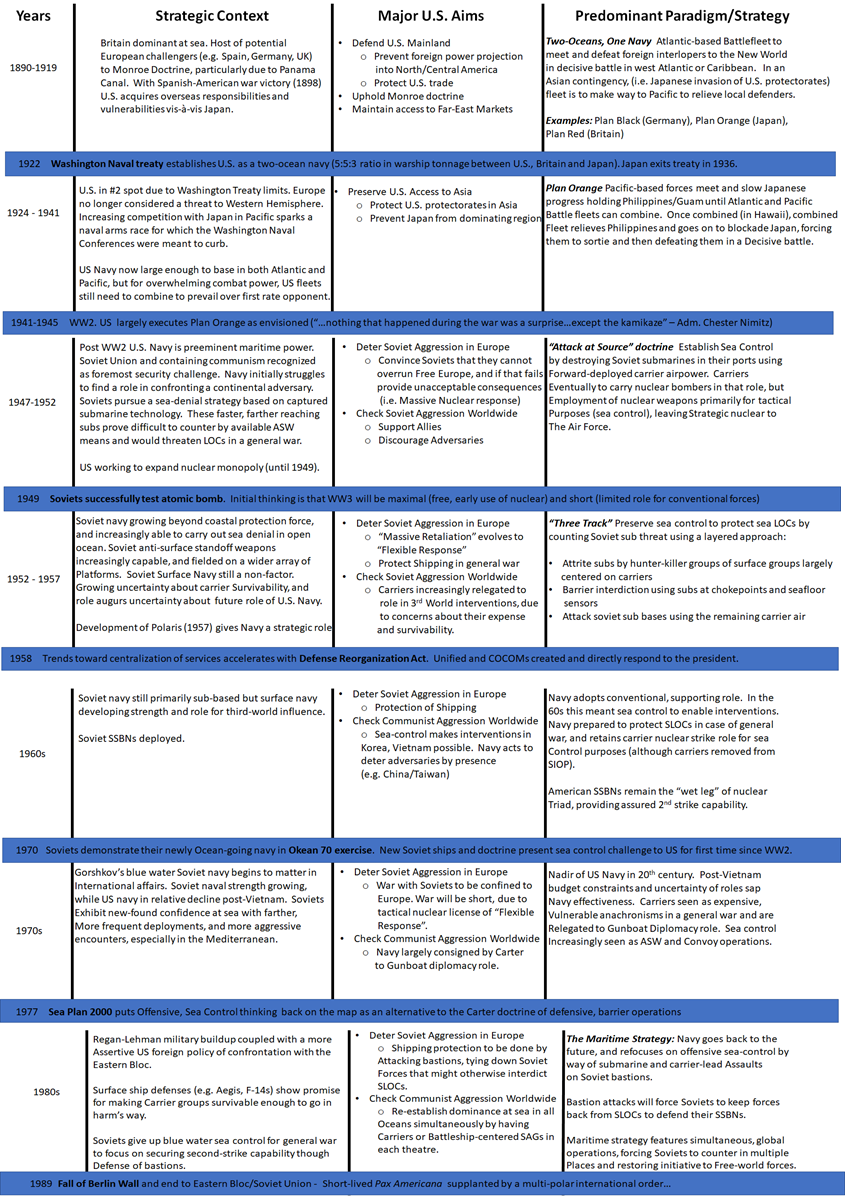
The modern American navy was born in the 1890s. Fears of European encroachment on the new world and newly acquired overseas responsibilities were met with growing American industrial might coupled with the vision of maritime power prophets such as Mahan to create a seaborne force that would matter in international affairs. In that decade, the U.S. navy rejected the traditional sea-denial (commerce raiders with Ironclads/Coastal artillery for harbor defense) concept to become a sea-control force centered on a battle fleet.
The Maritime Strategy of the 1980s
The Maritime Strategy of the 1980s represented the high water mark of the US Navy in so many ways; resources, political clout, international influence and combat power. The strategy, and the thinking behind and around it generated by both military and civilian members of the defense community was a return to form, marrying the concepts of offensive sea control to the Mahanian concept of decisive battle (in this case not a single battle but a fight the adversary can not refuse). Norman Freidman summed up The Maritime strategy most neatly in “The US Maritime Strategy” here:
The Maritime Strategy, as developed explicitly since 1982, revives a classic equation: that sea control can most effectively be seized and maintained through the early destruction of the enemy navy, i.e., through projecting sea power into his operating and base areas. Moreover, the threat of that projected power (against such valued assets as his strategic submarines) is intended to force the enemy into an early decisive battle. Promptness is important for two reasons. First, it prevents the enemy from dispersing his forces into the open ocean, where they can do enormous damage before they are tracked down and killed. Second, it frees up power projection forces to affect the land battle, which is almost certainly going to be part of the larger conflict in which the naval war is embedded.
A study of the Maritime Strategy seemed to be a good place to start analysis of US naval strategies for two reasons. The first reason is that the idea of seizing the initiative through offensive means of sea control is in the US maritime strategic DNA. While we may occasionally stray towards seaborne Maginot-like constructs such as barrier ASW for cost saving reasons occasionally, the US institutional memory and values favor initiative and positive action as the means to win conflicts. Secondly, there are many issues in the Maritime Strategy that are still relevant today (e.g. how to project power into contested areas ~ A2AD).
My unstated 3rd reason is that I wanted to get a particular game on the table – the aforementioned “Seapower and the State” from the beginning of this post.
I will cover my selected critiques of the Maritime Strategy and appreciation of the situation represented and associated hypotheses I want to tackle using this game in subsequent posts.
For Further Reading:
Freidman, Norman “The US Maritime Strategy“. Naval Institute Press; 1st Ed. (U.S.) edition (1988)
Baer, George W. “The U.S. Navy, 1890-1990 – One Hundred Years of Sea Power“. Stanford University Press (July 1, 1996)
Palmer, Michael A. “Origins of the Maritime Strategy“. Naval Institute Press (1990)